Monster Factory
One Insert. Filthy to Pristine. Build the Monster or Build the Hit - the Same Chain Does Both.
Monster Factory
Perpetual license - pay once, own it forever.
By purchasing you agree to our EULA and Privacy Policy.
Heavy or Pristine, Filthy or Radio-Ready.
One Chain Covers All of It.
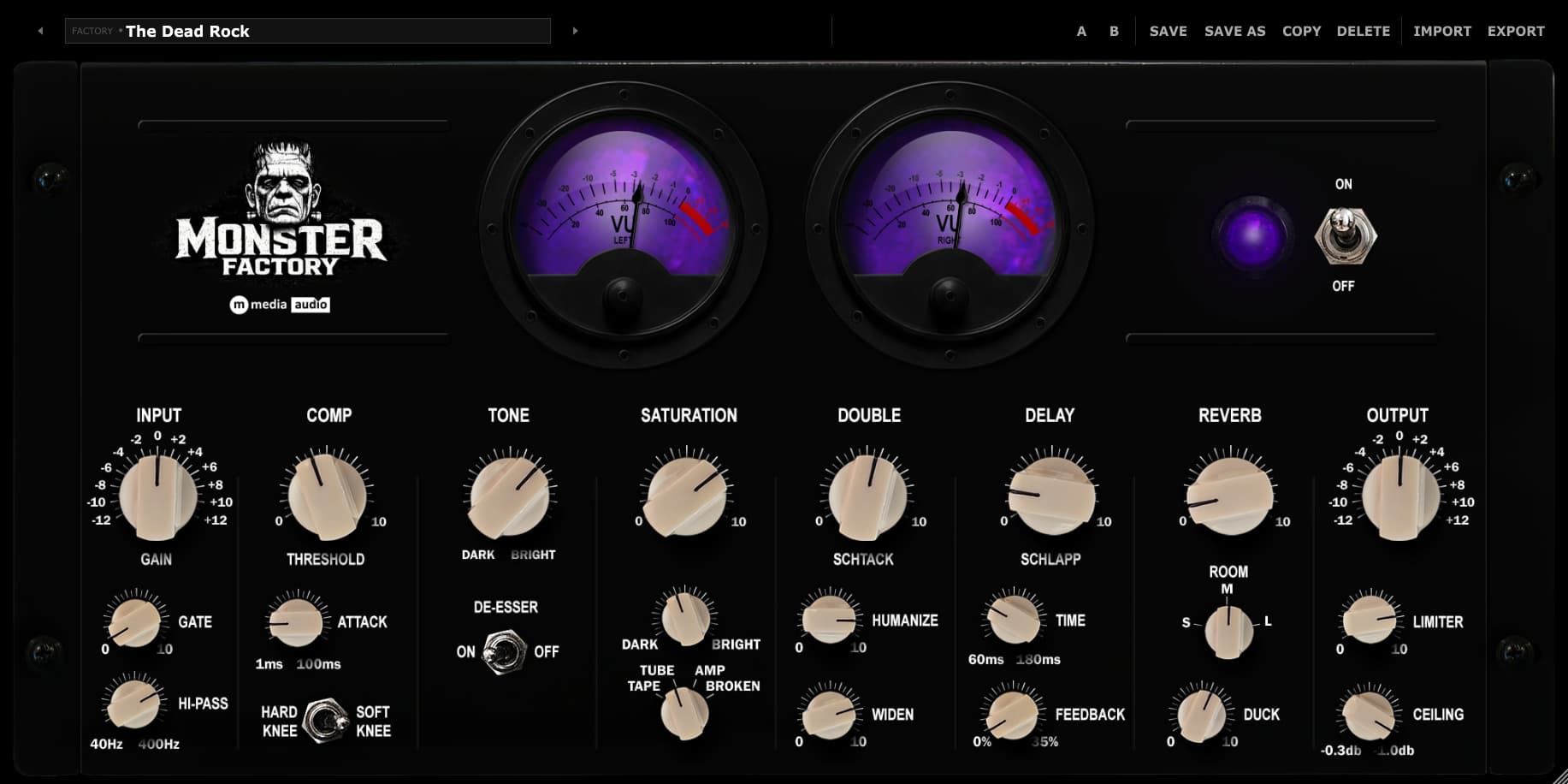
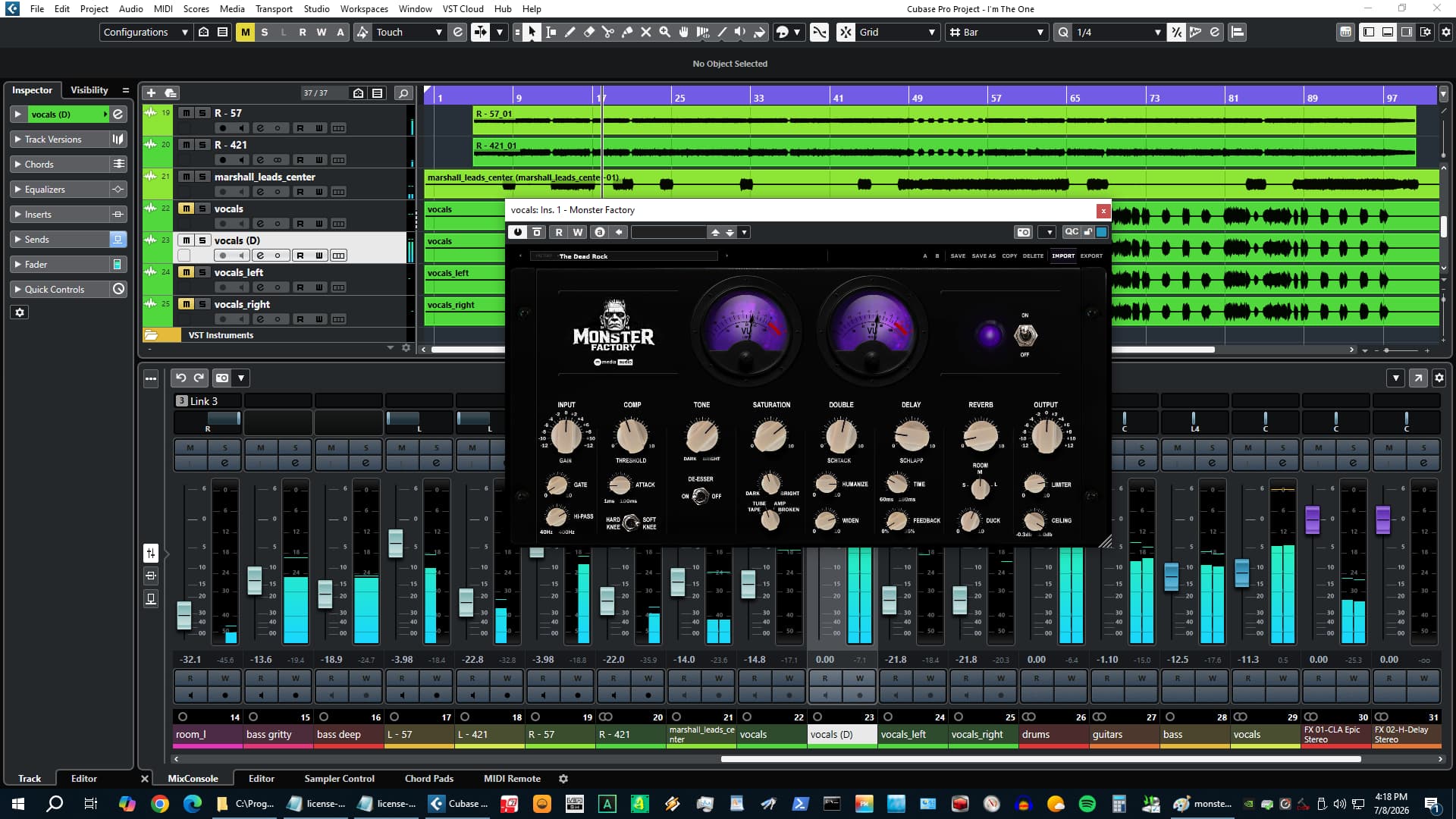
Push the Grind into AMP or BROKEN and a guitar track turns aggressive and saturated - thick, mean, and worked. Back off to TAPE with the compressor soft-kneed and a vocal sounds warm and expensive. The Schtack doubler builds the wall. The Schlapp slapback puts the source in a physical space. The reverb ducks itself out of the way when the signal is present and blooms into the gap when it isn't. The final limiter holds whatever ceiling you set.
That is the same chain. Same insert. The difference is where the knobs are sitting. Monster Factory is set up so that turning things up adds character and turning them back removes it - the stages do not fight each other. Drop it on a metal vocal, a pop hook, a hip hop 808, a screaming guitar - dial it to where it sounds right and move on.
Drop it on a vocal. Any vocal.
Gate closed, Grind at TUBE, Schtack at noon.
Then decide how far you want to push it.
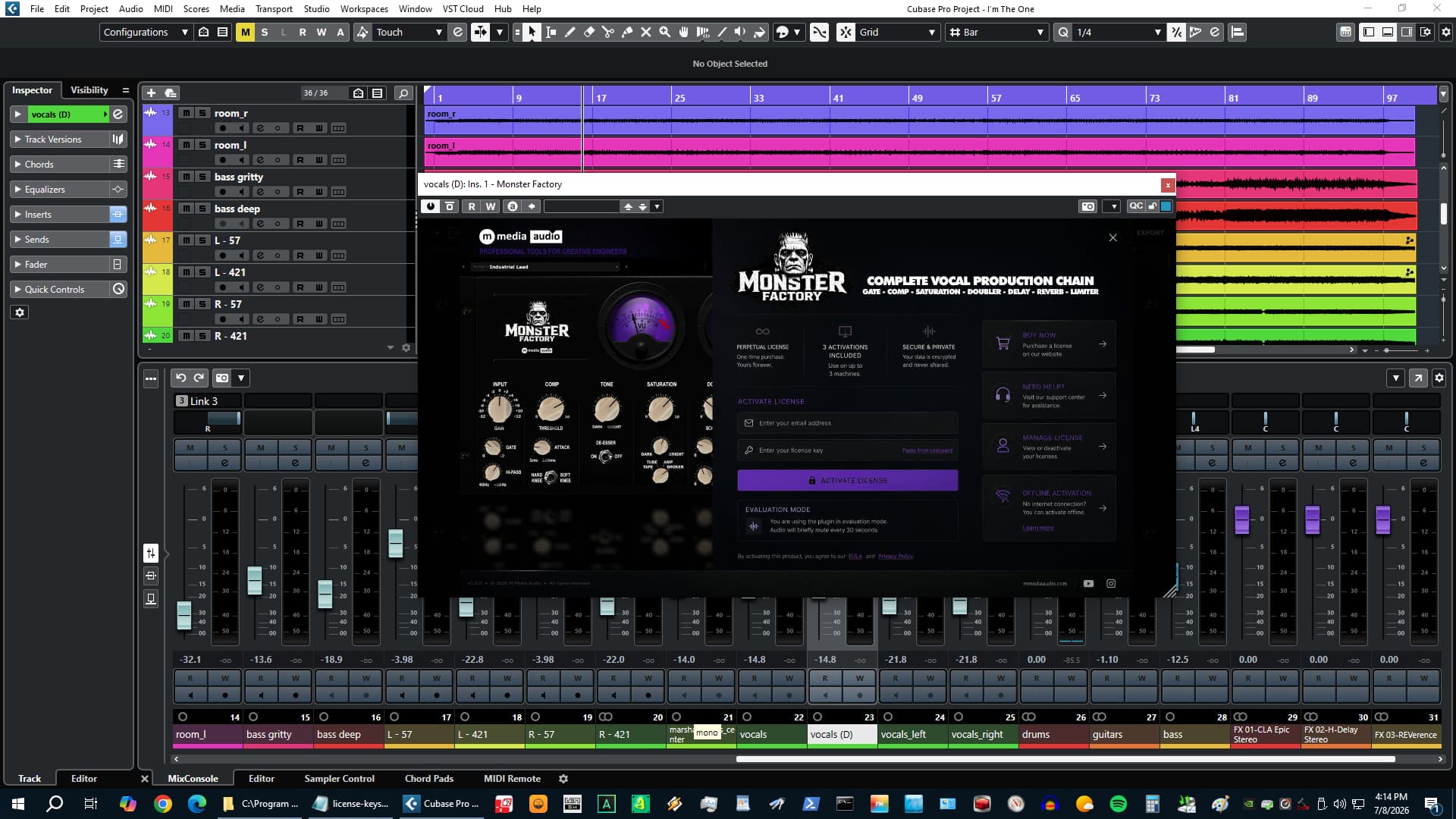
No account required - we send the link to your email. Silences briefly every 30 seconds in demo mode.
The Front End
Kill the Noise, Cut the Low End, Clamp It Down.
Now Hand It to the Chain.
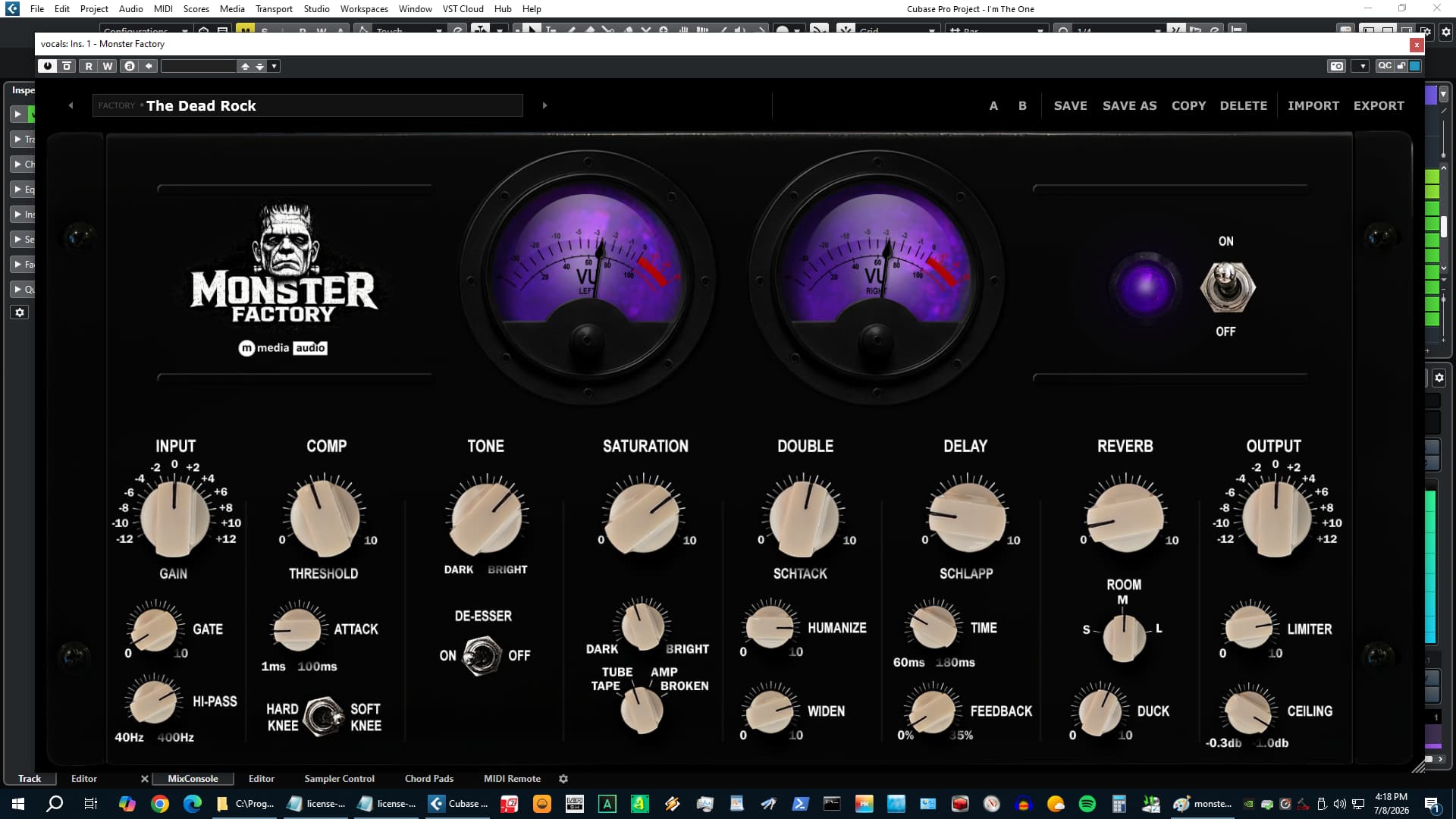
A screamed vocal has bleed and room. A close-mic'd pop vocal has breath and proximity. A distorted guitar has low-end rumble that has no business reaching the compressor. The gate closes in the silences using an amount knob - no threshold to find, just dial in how aggressively it closes between transients. The HPF cuts from 40 to 400 Hz before anything else sees the signal, which means the compressor is responding to the material you care about instead of pumping on a low-end thump. By the time the signal reaches the Grind and the doubler, it has already been controlled. Everything downstream works better for it.
- Input Gain - +/-12 dB trim before anything else runs
- Gate - Amount control, 0-100%, closes between transients
- High-Pass Filter - 40-400 Hz, log-scaled, removes low-end buildup before compression
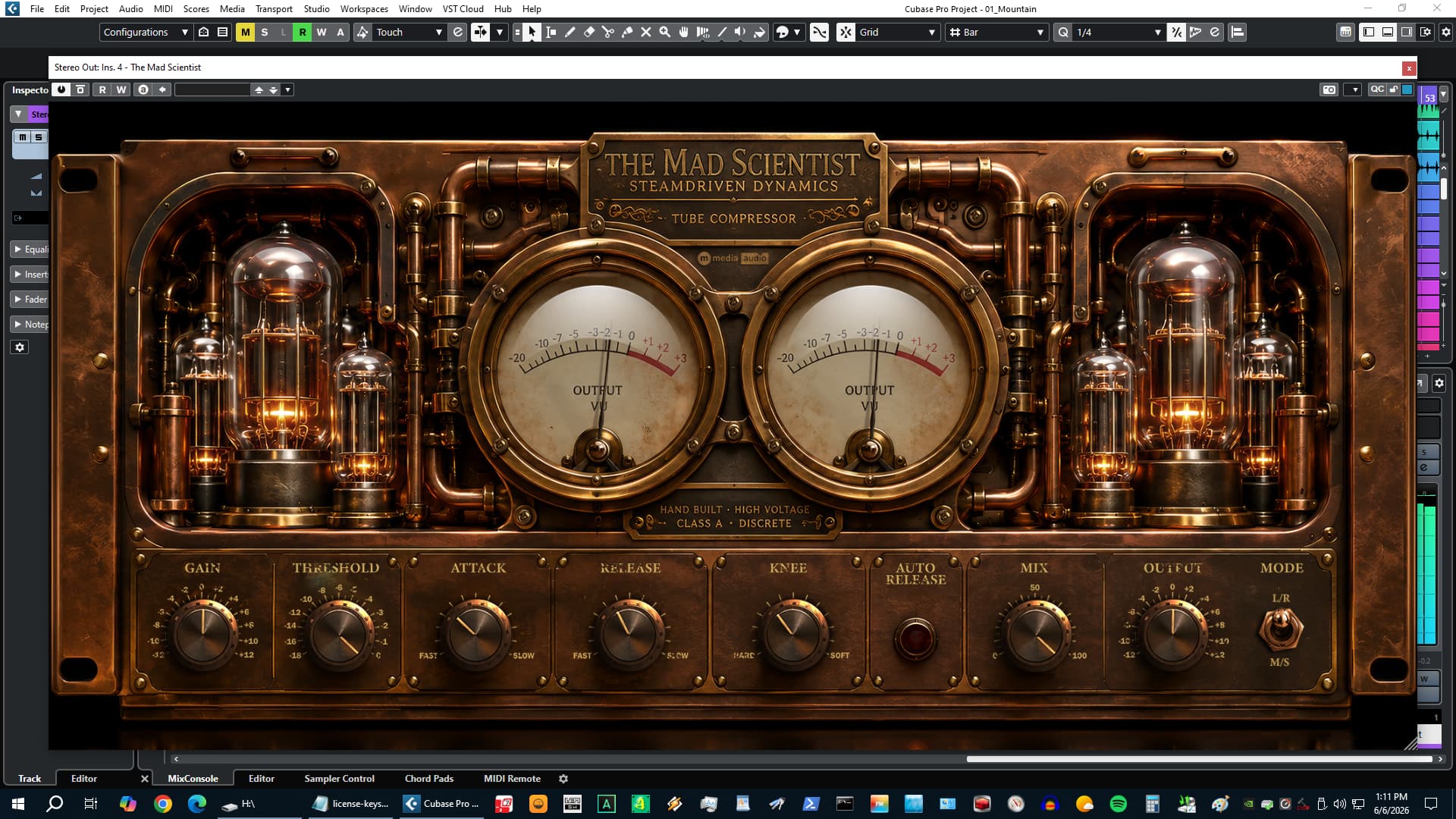
- Compressor - Threshold, Attack 1ms-100ms, Hard/Soft Knee switch
The Character Engine
TAPE Warms It. TUBE Bites. AMP Slams. BROKEN Does Damage.
Grind runs in parallel - the dry signal never gets touched, you're blending character in on top of it. TAPE is the polished end: even-harmonic warmth that makes clean material sound like it was recorded through something with actual weight. TUBE adds the asymmetric odd-harmonic edge that turns a thin vocal into something that has presence without getting harsh - the mode engineers reach for when a track needs to cut without needing to be loud. AMP opens up under drive and gets aggressive: heavy guitars, distorted bass, hip hop 808s that need attitude, anything that should sound like it means it. BROKEN is what happens when you push past that. Complex harmonics, deliberate grit, the sound of something worked hard enough that it started giving back in ways it wasn't designed to. The Grind Tone knob tilts the saturation path dark or bright before it hits the blend.
- TAPE - Smooth even-harmonic warmth, gentle soft-limiting on the parallel path
- TUBE - Odd-harmonic edge, asymmetric curve, presence and bite
- AMP - Input-stage clipping that opens up under drive, harder character
- BROKEN - Past design limits - complex harmonics, deliberate grit
- Grind Tone - Tilts the saturation path dark-to-bright before the blend
- Saturation - 0-100% blend of the parallel Grind signal
Thickness + Space
Schtack Builds the Wall. Schlapp Puts It in a Room.
The Schtack doubler thickens the signal. Humanize randomizes the timing and pitch on the doubled path so it sounds like a second performance instead of a copy - the difference between a vocal that sounds stacked and one that sounds like someone actually sang it twice. Turn Widen up and the doubled signal spreads across the stereo field. Increase Schtack on a metal vocal and it starts filling in the space around the center. On a clean pop hook it turns one voice into something that sounds like a section. The Schlapp slapback delay follows at 60 to 180ms - designed to add the physical sense of a room, not echo. A dry vocal with Schlapp turned up sounds like it was recorded in a real space. A guitar track already pushed through AMP Grind sounds like an amp in an actual room rather than a plug-in doing its best impression of one.
- Schtack - Doubler thickness, 0-100%
- Humanize - Micro-variation in the doubled signal's timing and pitch
- Widen - Stereo spread of the doubled signal
- Schlapp - Slapback send amount
- Delay Time - 60-180ms range
- Delay Feedback - 0-35%, short repeats only
Depth + Final Ceiling
A Reverb That Stays out of the Way.
A Limiter That Holds the Line.
The reverb runs Small, Medium, or Large - broad categories that let you pick the physical sense of the space and then dial Amount to decide how much of that space actually shows up in the sound. Duck pulls the reverb level down when the source is hot and lets it come back up in the gaps. What this means practically: a screamed vocal can have a room behind it without the reverb washing over the attack. A clean pop vocal can have genuine air around it without sounding like it was recorded in a cathedral. The reverb adds context; it doesn't compete for space. At the end of the chain, a final output level trim and a brickwall limiter with a ceiling from -0.3 to -1.0 dBFS close it out. Set the ceiling to where it needs to be and leave it. The chain from front to back does the rest.
Selected Work
Perpetual License
One-time purchase. Yours forever. No subscription, no renewal.
3 Activations
Install on up to three machines simultaneously. Need to move a license? Email us.
Secure & Private
Encrypted activation over HTTPS. No telemetry. No data leaves your machine during use.
Direct Support
You email us, we answer. No ticket queues, no bots, no knowledge base rabbit holes.
System Requirements
Format
VST3 (64-bit) - Windows, macOS, Linux
AU (64-bit) - macOS only
Platform
Windows 10 / 11
macOS 11 Big Sur or later (Apple Silicon + Intel)
Linux - Ubuntu 22.04+ or equivalent
DAW Compatibility
Any VST3-compatible host: Reaper, Cubase, Studio One, Ableton Live, FL Studio, Bitwig Studio, Nuendo, and more
AU (macOS): Logic Pro, GarageBand, MainStage
License
Perpetual, single user
3 simultaneous activations
Need to move a license? Email us
SHA-256 (mmedia-monster-factory-v1.0.0.zip): c61de7bae2f62ea0ce8aebcdfc5907b133ef45fdb59d3931e419be9259a5abb5
Monster Factory
Perpetual license - pay once, own it forever.
By purchasing you agree to our EULA and Privacy Policy.
Pro Audio
KVRDC26: Session Loops PitchNet - Free Natural Vocal Tuning Plugin for macOS & Windows, AU, VST3, AAX & Standalone Application
The KVR Developer Challenge 2026 is now at the download and voting stage; it's time to focus on each of the 56 entries that are available now, for free, for everyone. PitchNet by Session Loops...
London Symphony Orchestra upgrade LSO St Luke’s studio
LSO St Luke’s have recently launched brand new recording facilities as part of a multi-million-pound investment in their creative and technical infrastructure.