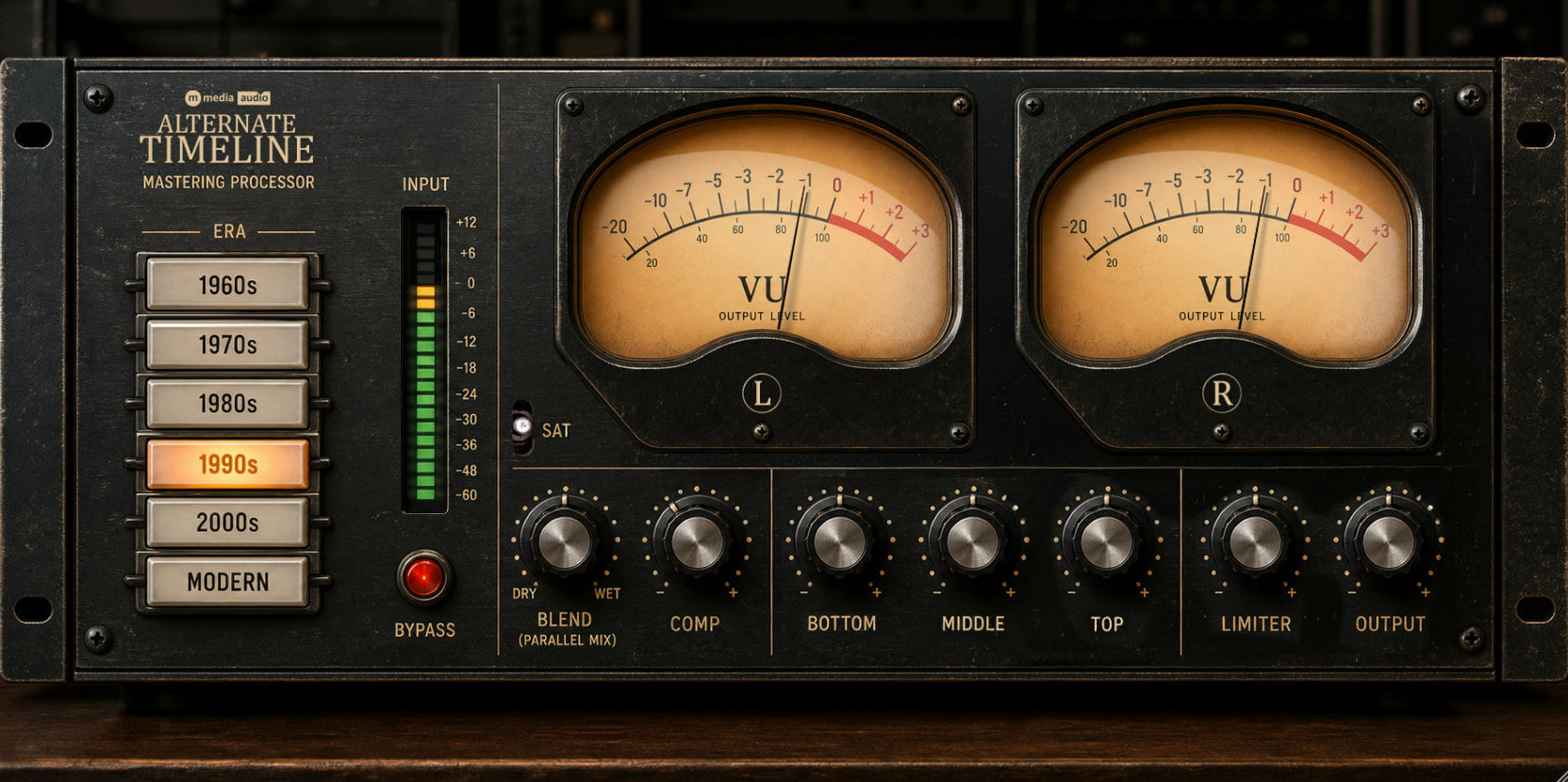
Alternate Timeline: Mastering Through the Decades Without Leaving the Box
Every record carries the fingerprints of the era that made it. Not just the songs, not just the performances, not just the gear sitting in the room, but the limits and habits of the recording format itself. A 1960s record does not feel like a 1960s record only because someone used tape. It feels that way because the low end was managed differently, the top end stopped earlier, stereo was treated like a newly discovered superpower, and saturation was not an effect so much as weather.
Alternate Timeline was built around that idea. It is not a generic “vintage” button. It is not a fake dust-and-crackle machine. It is an era mastering processor designed to reshape EQ, compression, stereo width, and saturation behavior according to the way records actually changed across decades.
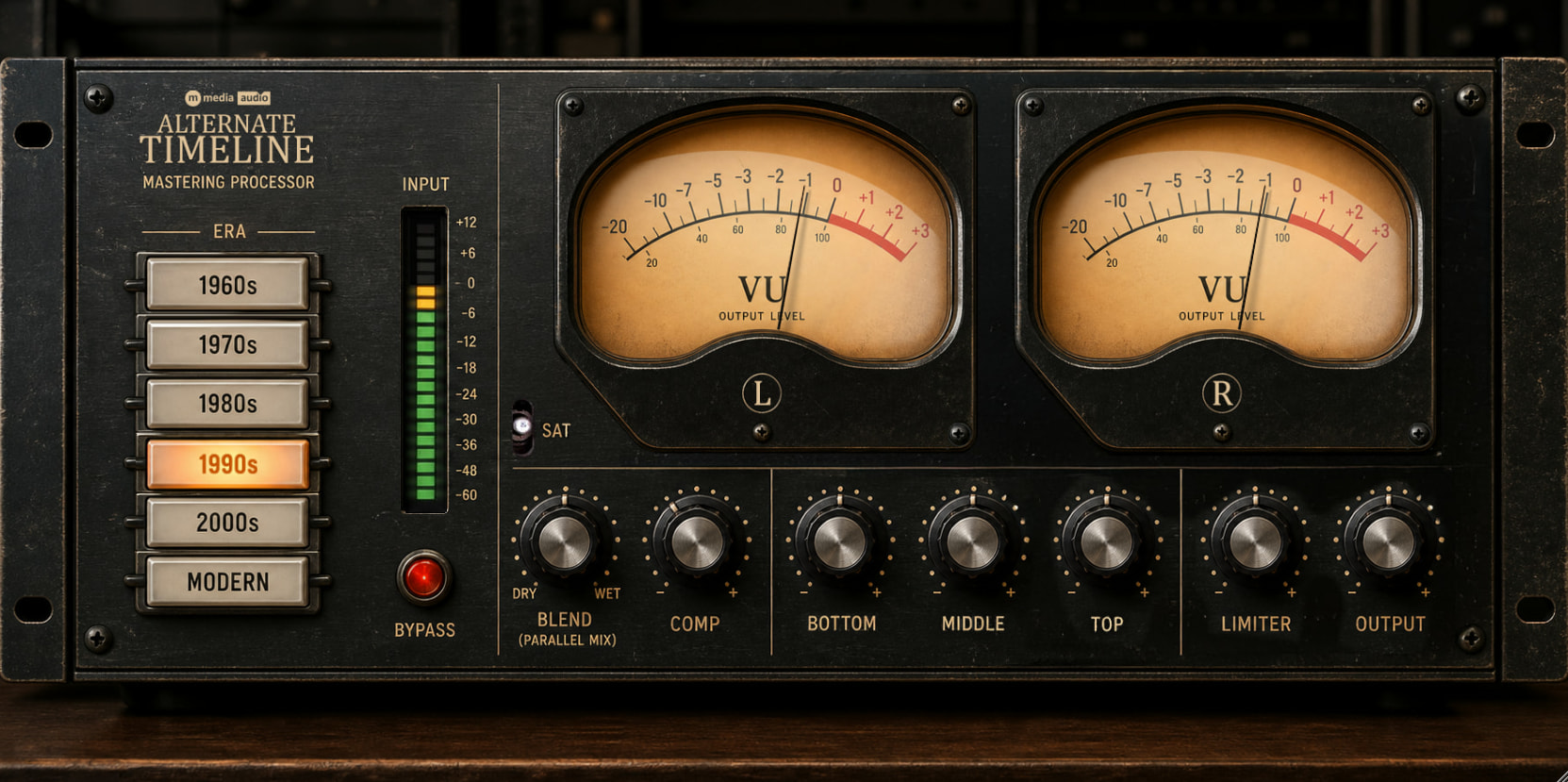
The concept is simple: choose the era you want your mix to lean toward, then let the processor apply a carefully tuned mastering profile. The plugin includes decade-based profiles for the 1960s, 1970s, 1980s, 1990s, 2000s, and Modern production. Each one adjusts the mix differently because each decade solved different problems.
The 1960s profile is not trying to create modern sub extension, because that was not the world those records lived in. The high-pass point is higher, the top end is darker, and the stereo image allows for the hard-panned, psychedelic behavior that made early stereo records feel wide in a way that modern mixing usually avoids. The result is not a cartoon of the 1960s. It is a controlled version of the format pressure that shaped those records.
The 1970s profile opens the low end, eases the compression, and moves toward the warmer, more confident sound of records made when studios had become deeply skilled at analog production. There is weight, width, and a sense of console-era polish without turning the mix into a museum piece.
The 1980s profile reaches higher. The top end gets brighter, the midrange changes character, and the compression gets more assertive. This is the era of cleaner recording, bigger presentation, gated ambition, and mixes that wanted to sound expensive even when the snare drum was trying to take out a wall.
The 1990s profile is the center of gravity. It is the default for a reason. By the 1990s, the recording format had stopped fighting the engineer as aggressively. CD gave engineers full-range audio without the rumble, noise, and physical compromises of earlier formats. Mixes could carry real sub energy, real air, and real dynamics at the same time. The loudness war had not fully flattened everything yet. The best records of the decade had density, clarity, and breath.
That balance is what the 1990s profile is designed to capture. It lets sub energy live, adds weight around the kick and bass relationship, gives the presence region a controlled push, opens the top end, and uses compression for glue rather than punishment. It is clean without being sterile, polished without being crushed, and modern enough to translate without sanding the music into a brick.
The 2000s profile moves into a more aggressive zone. Compression becomes faster and stronger, the top end is brighter, and the overall behavior reflects the early loudness-war mindset. This is useful when a track needs that forward, dense, competitive feeling, but it is intentionally less relaxed than the 1990s setting. It is the sound of records discovering that digital headroom could be abused, and then asking for a bigger hammer.
The Modern profile keeps the sound controlled, polished, and current without pretending that every modern mix needs to be obliterated. It borrows from contemporary mastering habits while staying usable as a musical processor rather than a blunt loudness tool.
One of the most important parts of Alternate Timeline is the saturation switch. Each era has its own saturation behavior, but the faceplate gives you a three-position control: full era saturation, half saturation, or no saturation. That matters because not every mix needs another layer of harmonic density. If your drums, buses, tape plugins, or synths are already adding color, you can reduce or remove the saturation and keep the EQ, compression, and width behavior intact.
That is the point of the design. Alternate Timeline is not about forcing nostalgia onto a track. It is about giving the mix a different historical operating system. A 1960s-inspired master should not behave like a 2000s master with a darker EQ. A 1990s-inspired master should not just be “less bright.” A modern master should not be reduced to “make it louder.” The profiles work because they move several musical and technical assumptions together.
Use Alternate Timeline when a mix feels technically fine but emotionally unplaced. Use it when a track needs the open confidence of the 1990s, the warmer footprint of the 1970s, the brighter push of the 1980s, or the dense impact of the 2000s. Use it when “make it sound more vintage” is too vague and “make it sound mastered” is not enough.
Alternate Timeline is a VST3 processor for Windows 10 and 11, built for producers, mixers, and mastering-minded engineers who want era character without surrendering control. It gives you decade-based mastering behavior in one focused tool: EQ, compression, saturation, width, and output behavior working together instead of a pile of disconnected plugins pretending to be a time machine.
A good master does not just get louder. It belongs somewhere. Alternate Timeline gives your mix somewhere to go.