Killer Glue for Fast Transients
FET compressors have a sound that is hard to explain until you hear it – then it is impossible to un-hear. Fast transient response, a kind of forward energy that pushes material toward the front of the mix, and a harmonic character that comes from the transistor circuit itself. The Black Clamp is a dual-channel FET compressor built on that topology, and while it handles single-channel work without complaint, it is at its best when you put it across a bus. Drum bus. Mix bus. Overheads bus. Any bus where you need the sound to grab, lock together, and sit forward.
Here is how we use it.
On the Drum Buss
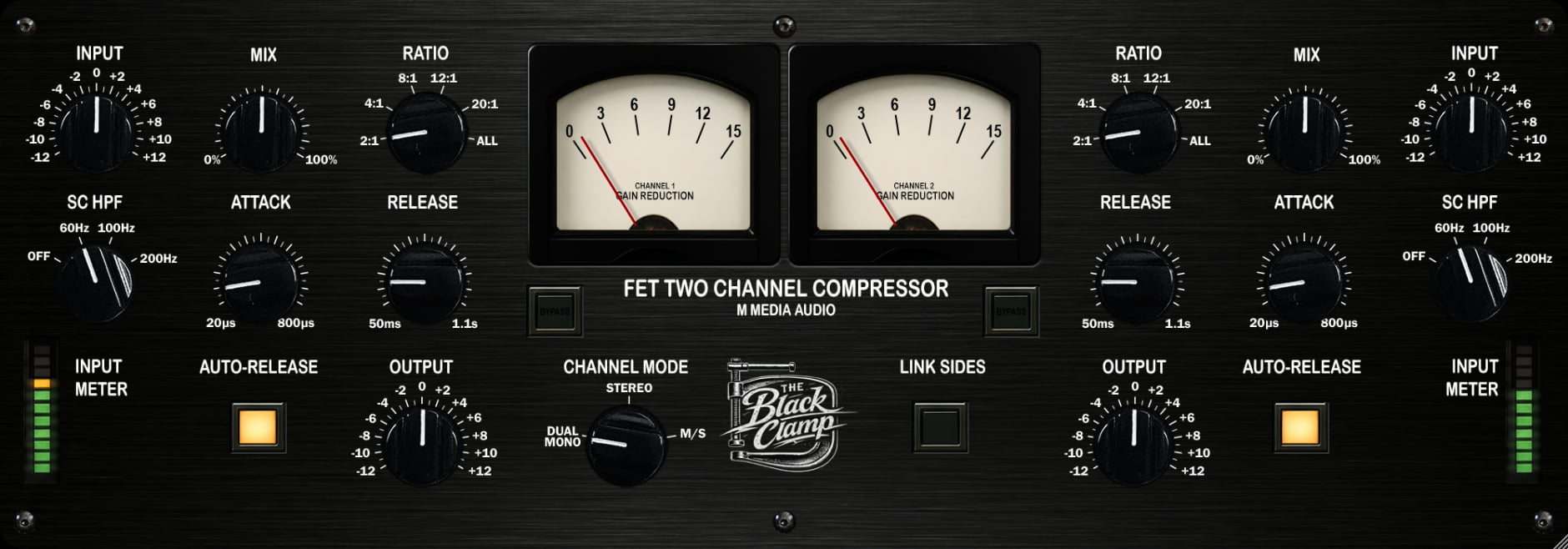
This is the natural home for a FET compressor. Drums have fast transients – kick and snare attacks that happen in microseconds – and the FET detector circuit is built to catch them. Set the Attack all the way fast (The Black Clamp goes down to 20 microseconds), a medium Release somewhere between 150ms and 400ms, and run the Ratio at 8:1. That is the workhorse position: controlled, punchy, not quite limiting. Push the Input hard enough to get 4-6 dB of gain reduction on peaks and you will hear the drum bus start to lock. The harmonic saturation that comes from the JFET input stage adds density and presence without a separate drive control – the Input level is the drive.
If the kick is pumping the whole bus too hard, engage the SC HPF. The 100 Hz position removes kick fundamentals from the detector circuit so the compressor reacts primarily to snare and midrange content. The kick still gets compressed – it passes through the gain reduction stage – but it is no longer what triggers it. The 200 Hz position tightens that further for very kick-heavy material.
Want more aggression? Try ALL mode. This is not a standard ratio position. The gain computer in ALL mode uses a modified curve with an early knee onset and heavy 2nd harmonic injection – approximately 12:1 effective but with a character that no standard ratio setting can produce. This is the British slam mode. Drums through ALL mode at fast attack and medium release pump, saturate, and breathe in a way that is entirely its own thing. Use the Mix knob to blend it back against the dry drum signal so the transient snap stays intact while the body of the ALL character comes through underneath.
On the Mix Buss
Mix buss compression is a different discipline. The goal here is glue – elements that feel like one record rather than twenty tracks playing at the same time. That requires restraint: lower ratios, moderate attack times (not so fast that you smash the front of every transient, not so slow that the bus bounces), and enough gain reduction to hear the effect without noticing it on any single hit.
Start at 4:1. Attack at 400-600 microseconds gives the transients a brief moment to pass before the compressor takes hold. Set the Release between 200ms and 500ms and listen to how it breathes with the tempo of the track. Run the Input for 2-4 dB of gain reduction – enough to feel the mix locking, not enough to feel squashed. In Stereo mode the sidechain sums both channels, so the compressor reacts to the combined signal and applies the same gain reduction to both – classic linked stereo bus behavior with a preserved stereo image.
The SC HPF matters here too. At 100 Hz, the detector ignores most of the kick and bass energy that would otherwise drive excessive gain reduction on every beat. The compressor responds to the mid and high content of the mix – vocals, guitars, synths – and the low end passes through with far less triggering. At 200 Hz, the correction is stronger – useful on modern mixes with particularly loud sub content.
The Mix knob is parallel compression built into the plugin. Blend at 60-80% for most mix buss work: the compressed signal provides glue and density, the dry signal preserves the transient detail that full wet compression would soften. This is the fastest path to New York-style parallel processing without any extra routing.
M/S on the Mix Buss
Switch to M/S mode and the left strip handles the Mid channel, the right strip handles the Side channel, and both get processed independently. This is powerful on mix buss because it lets you compress the center and sides with completely different settings. The mid – your kick, snare, bass, lead vocal – often needs more gain reduction and tighter time constants. The side content – room mics, wide guitars, stereo synths – usually needs a lighter hand so the width stays open.
Compress the Mid at 4:1 with moderate attack and moderate gain reduction. Set the Side strip lighter – lower ratio, slower attack, less input drive. The result is a tighter, more focused center with a wide, open stereo field that does not collapse under the compressor. Link is available in M/S mode but rarely the right call: Mid and Side almost always need different settings by definition.
Dual Mono and Parallel Processing
Dual Mono mode gives each channel a fully independent detector and gain computer. On a drum bus, that means the left overhead and the right overhead each compress based on what they see – if one side is louder, it gets more gain reduction without dragging the other side down. On a parallel compression return, it means you can set completely different compression curves on two different sources using a single plugin instance.
The Mix knob is always independent in any mode. Link mode mirrors all control positions from the left strip to the right for fast stereo setup, but it does not lock them – adjust the right strip after linking and it holds its position. The left channel is the reference; the right is always free to diverge.
A Few Starting Points
Drum Bus – Punchy: Linked, Stereo mode, 8:1, Attack 60µs, Release 250ms, SC HPF 100 Hz, Mix 80%, Input for 4-6 dB GR.
Drum Bus – Aggressive: Linked, Stereo mode, ALL, Attack 20µs, Release 200ms, SC HPF 60 Hz, Mix 50%, push the Input hard. Listen to what it does.
Mix Bus – Glue: Linked, Stereo mode, 4:1, Attack 500µs, Release 300ms, SC HPF 100 Hz, Mix 70%, Input for 2-3 dB GR.
Mix Bus – M/S: M/S mode, Mid strip at 4:1 / 300µs / 200ms, Side strip at 2:1 / 600µs / 400ms, SC HPF 100 Hz on both. Adjust per track.
The Black Clamp is $39. Windows, macOS, and Linux. VST3 everywhere, AU on macOS. The demo runs the full plugin with no feature restrictions – try it on your drum bus before you buy it.