Two new plugins are out this week. They solve different problems and were built independently, but they arrive at the same moment – so here is what both of them are and why they exist.
Monster Factory
Monster Factory started from a problem we kept running into: a session has three vocalists, two genres, and the wrong channel strip for at least one of them. Metal vocal, hip hop 808, clean pop hook – these are not the same signal or the same processing need, but they all end up in the same mix, and cycling through different channel strip plug-ins per track adds friction and creates inconsistency in how things are handled.
The answer was a single insert with a complete chain that scales. Gate, high-pass filter, compressor, four-mode parallel saturation (Grind), stereo doubler, slapback delay, ducking reverb, final limiter – in fixed order, each stage doing its job before handing the signal downstream. The Grind stage is the one that determines the character of what comes out. TAPE warms. TUBE bites. AMP gets aggressive. BROKEN goes past that into deliberate grit. All four run in parallel against the dry signal. You blend in as much character as the material calls for.
The front end matters as much as the saturation. The gate does not use a threshold – it uses an Amount knob. Turn it up, it closes harder in the silences between notes; turn it down, it barely notices. The HPF cuts from 40 to 400 Hz before the compressor sees the signal, which means the compressor is responding to the part of the sound you actually want controlled. Those two decisions – no threshold dial, HPF before compression – make the front end fast to set and predictable in how it behaves across different source material.
The Schtack doubler uses a Humanize parameter that applies micro-variation to the timing and pitch of the doubled path. That one control is the difference between a doubled vocal that sounds stacked and one that sounds like someone actually sang it twice. The Schlapp slapback delay runs 60 to 180ms – short enough to read as room, not echo. The reverb ducks when the source is hot and comes back in the gaps. The limiter holds whatever ceiling you give it.
The same insert. Same knob order. The difference between a heavy guitar track and a clean pop vocal is where the knobs are sitting, not which plug-in is loaded.
Monster Factory – $49, free demo available →
Orbit
Autopanners have been around long enough that most engineers use them the same way: automate the pan position on a synth pad or a guitar lead, call it movement, move on. The result sounds like a pan knob being turned. It does not sound like something moving through a physical space, because panning alone is not how spatial positioning actually works.
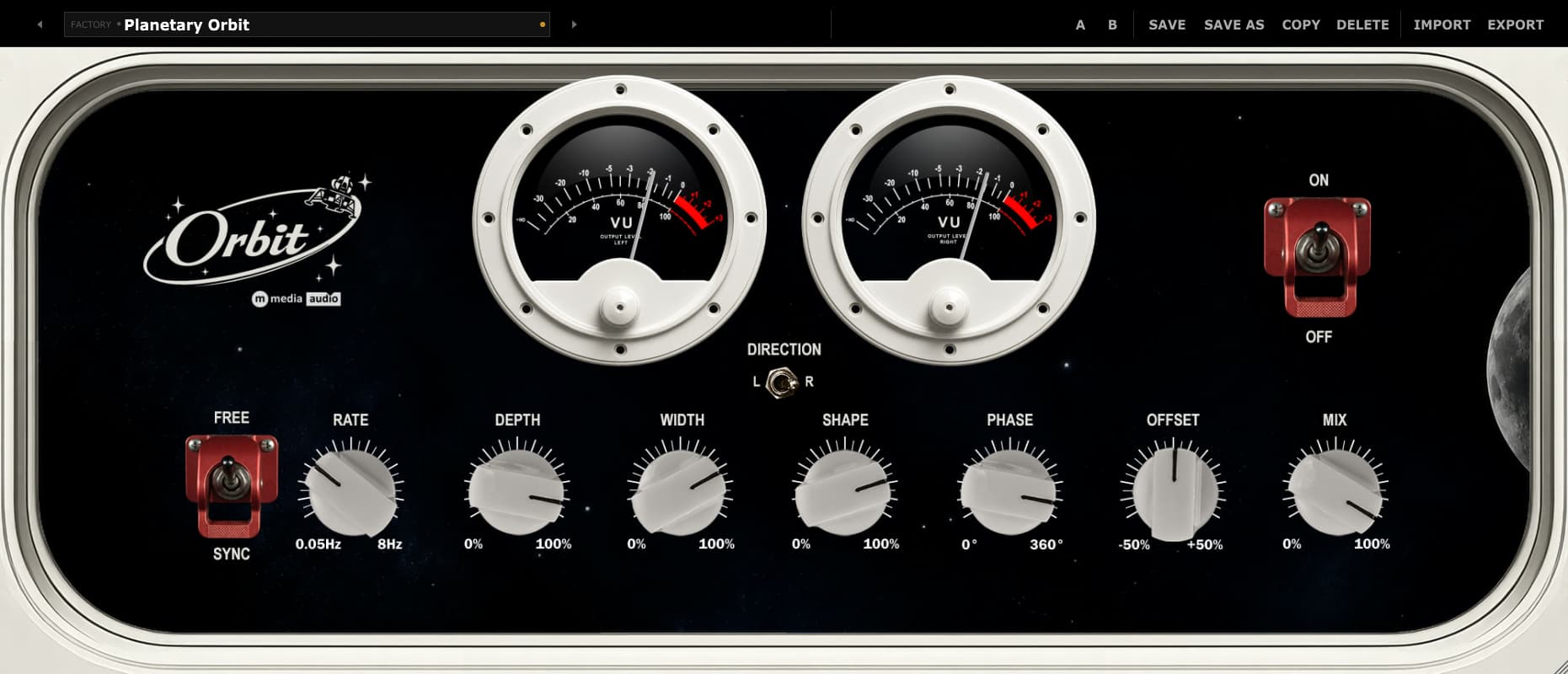
Orbit moves four things at once from a single LFO phase position. The pan travels left and right, equal-power. As it swings toward the front of the arc, the level rises and the high-frequency content brightens toward 18kHz. As it moves toward the rear, the level dips and the cutoff darkens toward 4kHz. At the same time, a Haas ITD delay of up to 650 microseconds hits the far ear, tracking the pan position. That timing offset is the binaural cue that tells your auditory system a source is somewhere in a room rather than embedded in a speaker. Put all four of those axes together at a Depth setting of 50% and a synth pad stops reading as “a sound with a panning effect on it” and starts reading as “a sound that is actually moving.”
The Rate runs from 0.05 Hz to 8 Hz. Slow rates work on sustained pads and ambient material – just enough to give something a sense of breath without obviously moving it around. Faster rates on more percussive material get rhythmic. Lock to tempo via Sync and set it to a quarter note and a hi-hat sample orbits in the grid. Set it to two bars and a chord pad glides through the field in time with the song.
Width goes to 200%, which extends past the normal stereo boundaries and gets genuinely strange in headphones. Phase sets the LFO start position so two instances can counter-orbit against each other – same Depth and Rate, one at 0 degrees, one at 180. Offset moves the center point of the arc left or right without touching the Width, useful when a source already needs to favor a side of the field. Mix blends the effect against the dry signal for when you want the movement felt more than noticed.
Nine presets are included, with plenty of room for your imagination to run wild. The default is called Planetary Orbit. It loads at a moderate rate and full width and works on almost anything without adjustment. Start there and decide what needs to change.
Orbit – $29, free demo available →
On Releasing Both at Once
These two were not planned as a bundle or a thematic pair. Monster Factory controls and shapes what is already there – it is an input-side tool. Orbit places a sound somewhere and moves it through a space. They ended up finishing at the same time and shipping together, which turns out to describe two adjacent decisions that happen on the same mix: what a sound is made of, and where it lives.
Both run Windows, macOS, and Linux in a single download. Demo modes are fully functional – both silence briefly every 30 seconds, no account needed to try them. Perpetual licenses with three activations each.
Browse the full plugin catalog at mmediaaudio.com/plugins.