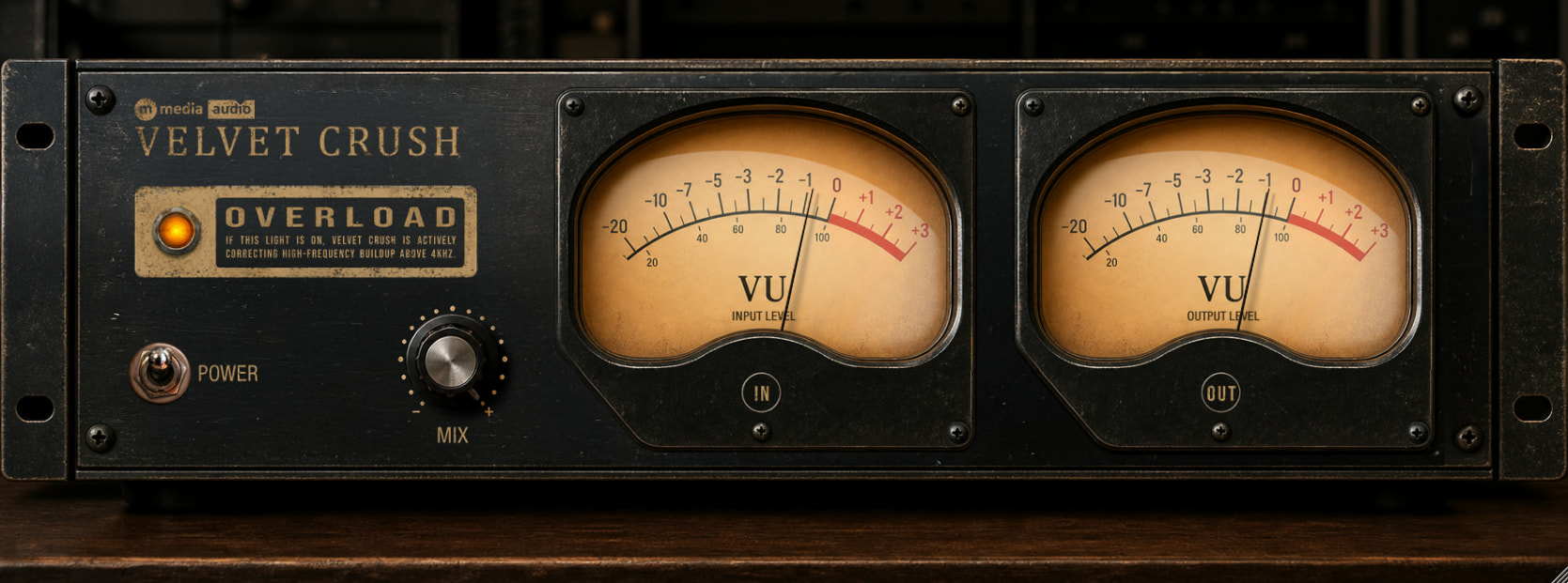
Velvet Crush: Smooth the Top End Without Killing the Air
Bright is easy. Smooth is hard. Anyone can add top end. A shelf here, an exciter there, a little sparkle, a little air, a little “expensive” sheen, and suddenly the mix feels alive on studio monitors. The problem is what happens later. The song hits earbuds, phones, streaming compression, laptop speakers, cheap tweeters, harsh car systems, and the beautiful shine turns into a tiny circular saw aimed directly at the listener’s forehead.
The shimmer becomes brittle. The vocal presence becomes a spike. Cymbals start behaving like aluminum foil in a microwave. The air band stops sounding open and starts sounding like digital grit with a marketing budget.
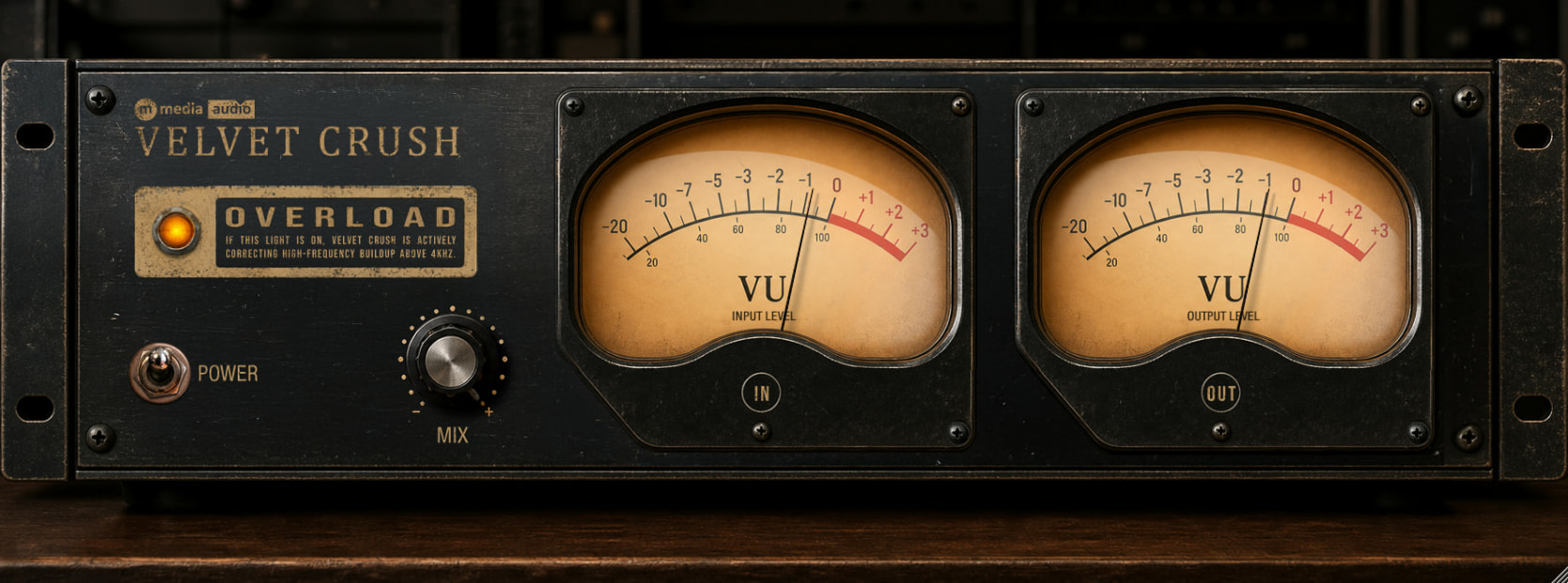
Velvet Crush was built for that exact failure mode. It is a dynamic high-end correction processor for everything above 4 kHz. It analyzes six high-frequency regions, compares their energy against calibrated translation targets, and applies gentle gain reduction where harshness, brittleness, or excessive edge is accumulating. It does not boost. It does not hype. It does not spray fairy dust over the mix and call it mastering.
It only removes what is getting in the way. The processor watches six zones: presence around 4.5 kHz, edge around 7 kHz, clarity around 10 kHz, sparkle around 12 kHz, air around 14 kHz, and ultra-high material around 18 kHz. These are the places where modern mixes can go from exciting to exhausting. A vocal can have too much bite. A synth can carry too much glass. Cymbals can stack into fatigue. Streaming compression can make already-bright material feel even harder. By the time the listener hears it, the problem is not “top end.” The problem is uncontrolled top-end behavior.
Velvet Crush handles that behavior dynamically. It analyzes the high bands, computes correction only where needed, smooths the response so the processing stays quiet, and blends the corrected signal with the dry signal. Everything below 4 kHz passes through untouched. The plugin is not reaching into the kick, bass, body, warmth, or lower midrange. It is focused on the part of the spectrum that most often makes a listener turn the volume down.
The Mix knob keeps the workflow direct. Start at midnight, listen, and decide how much correction belongs in the sound. High-frequency correction should not announce itself. If you hear it as an effect, it is probably too much. Velvet Crush is designed to be cumulative and subtle: a fraction of correction in several bands adds up to smoother listening without making the mix sound dull.
That is the difference between smooth and dark. A dark mix has lost energy. A smooth mix still has air, detail, dimension, and life. It simply no longer stabs the listener for owning tweeters. Velvet Crush aims for that controlled, extended top end associated with polished analog records and high-end console work. Not rolled off. Not cloudy. Not “vintage” as an excuse for missing information. Velvet.
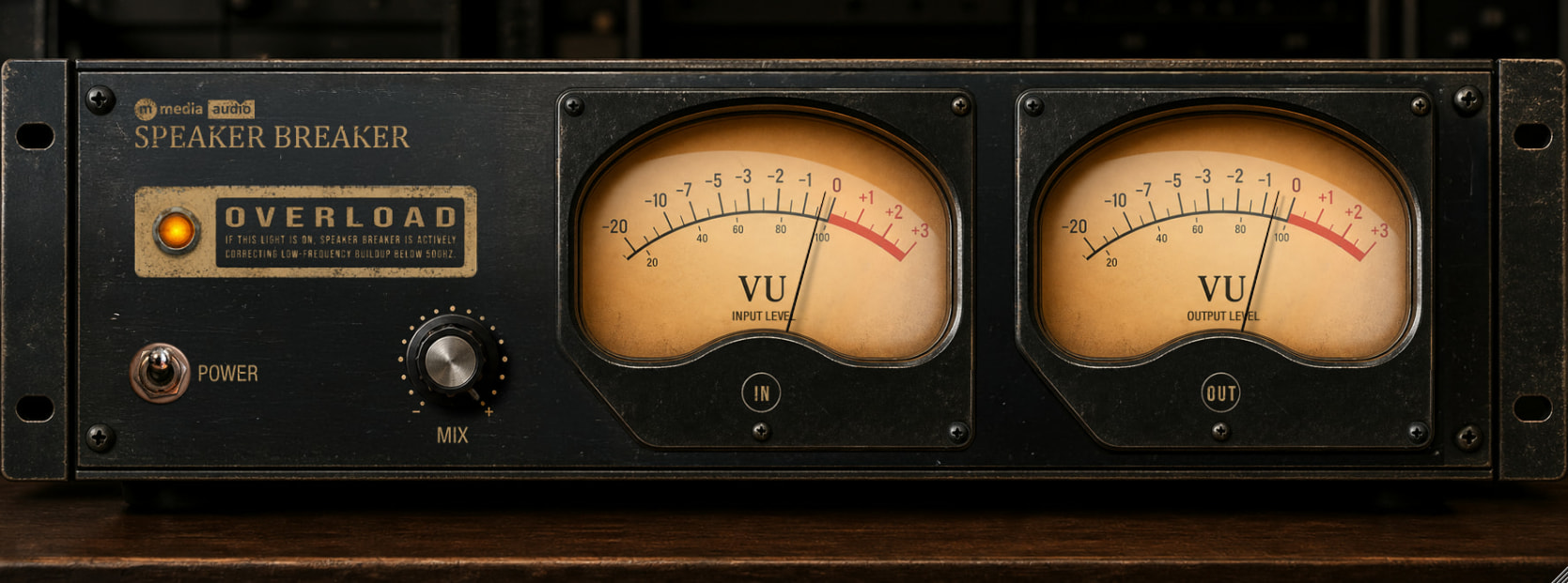
The metering keeps the process honest. The input and output VU meters show the signal before and after correction, while the pilot light illuminates when any high-frequency band is receiving gain reduction. Because high-frequency corrections are often small in absolute level, the light can come on for very subtle work. That is intentional. A half dB in the wrong high-frequency area can be the difference between polished and painful.
Velvet Crush is especially useful on mix buses, vocal buses, overheads, bright synth groups, acoustic instruments, and final 2-bus work where the top end needs control but not surgery. A vocal can stay present without spitting at the listener. Cymbals can stay open without sizzling into fatigue. A dense modern mix can keep its clarity without carrying that brittle digital edge that sounds fine for thirty seconds and miserable for three minutes.
The plugin is based on practical high-frequency energy management and listening research, including equal-loudness behavior and preferred response curves. That does not mean the plugin mixes for you. It means it has a sane idea of when the top end is starting to exceed useful musical energy and become translation risk. Use Velvet Crush when a mix sounds exciting but you cannot stop turning it down. Use it when earbuds reveal harshness your monitors were too polite to mention. Use it when the vocal is technically clear but emotionally annoying. Use it when the top end has detail but no mercy.
Velvet Crush is a Windows VST3 plugin with zero latency, stereo and mono support, and common production sample-rate support. It is a focused processor for producers and engineers who want a smoother top end without losing the air that made the mix feel alive in the first place.
Brightness gets attention. Smoothness gets replayed.