Three Focused Mix Tools: Alternate Timeline, Speaker Breaker, and Velvet Crush
Most plugin collections try to become a hardware store. A compressor for this, an EQ for that, a saturator with seventeen mythical tube moods, a limiter that promises competitive loudness and quiet regret, and a spectral thing that looks like it was designed by a submarine.
M Media Audio is taking a different route. Alternate Timeline, Speaker Breaker, and Velvet Crush are built as focused processors for real mix decisions. Each one answers a specific question that comes up again and again in production and mastering:
Where does this mix belong?
Can the low end survive real speakers?
Can the top end stay exciting without becoming painful?
Those are not small questions. They are the questions that decide whether a mix feels finished or merely exported.
Alternate Timeline: Give the Mix an Era
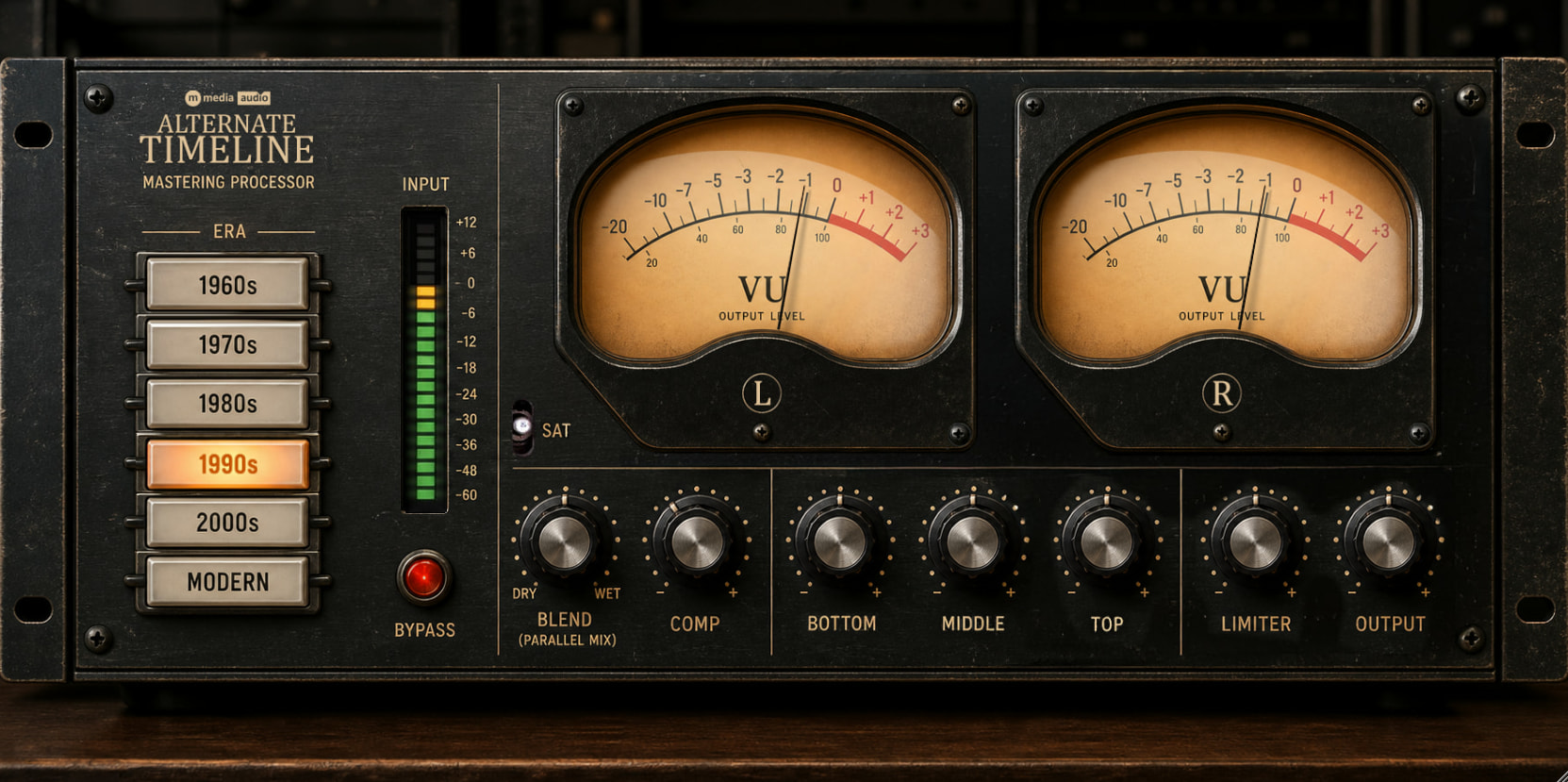
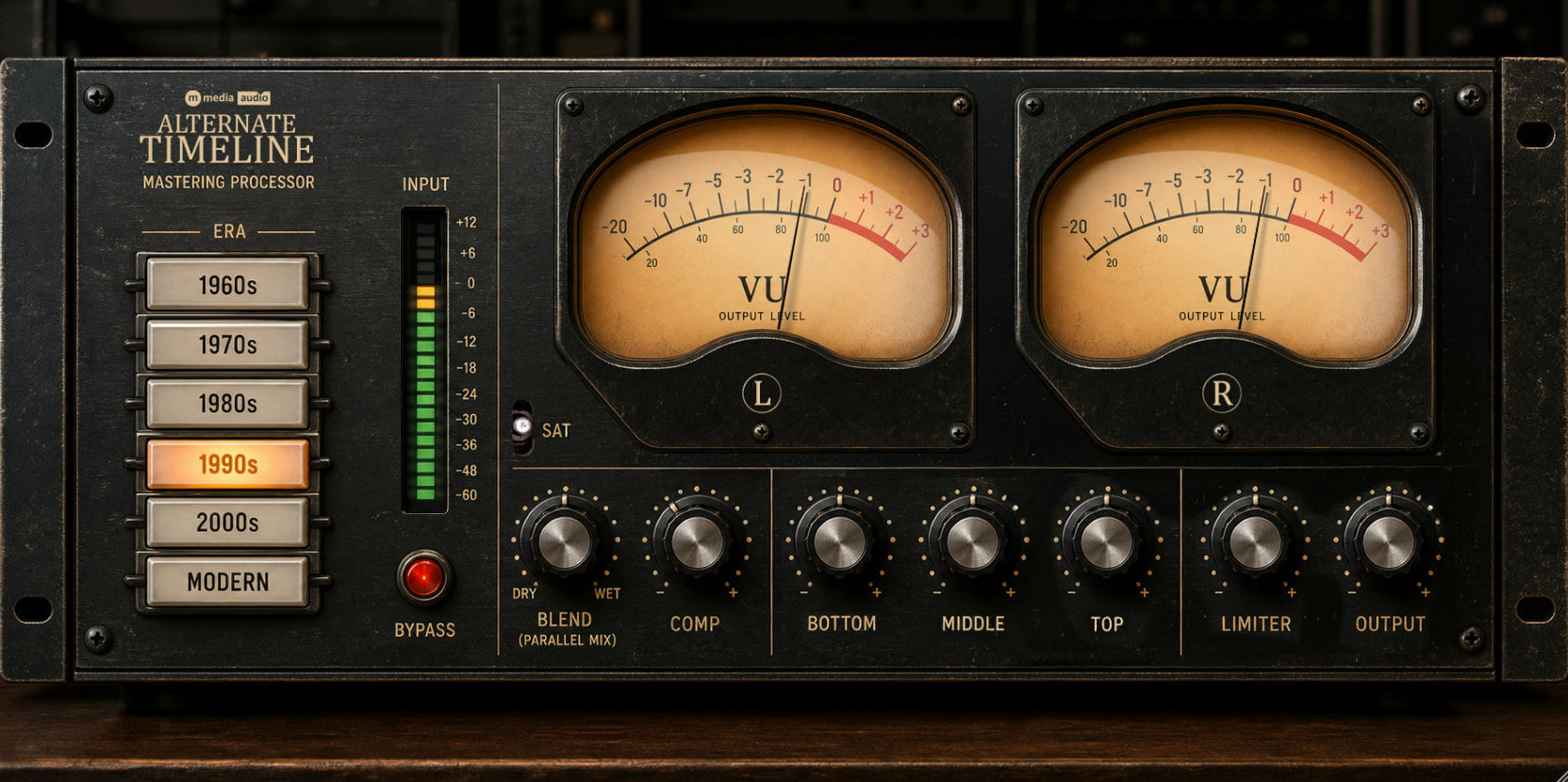
Alternate Timeline is an era mastering processor. It gives a mix decade-based mastering behavior across EQ, compression, saturation, width, and output feel. The idea is not to fake old equipment or bury a track under nostalgia. The idea is to understand that records from different decades behaved differently because engineers were working inside different technical realities.
The 1960s profile manages sub and top end differently because tape, vinyl, and early stereo demanded different decisions. The 1970s profile moves toward warmth, weight, and analog polish. The 1980s profile gets brighter and more assertive. The 1990s profile captures the clean, open, dynamic confidence of the CD era before the loudness war fully took over. The 2000s profile leans into density and aggression. The Modern profile offers a current, controlled mastering direction without turning the mix into paste.
Alternate Timeline is useful when a song sounds technically acceptable but emotionally undefined. Sometimes a mix does not need another EQ move. It needs a frame. It needs to feel like it belongs to a world. Alternate Timeline gives it one.
Speaker Breaker: Control the Low End Before the Real World Does
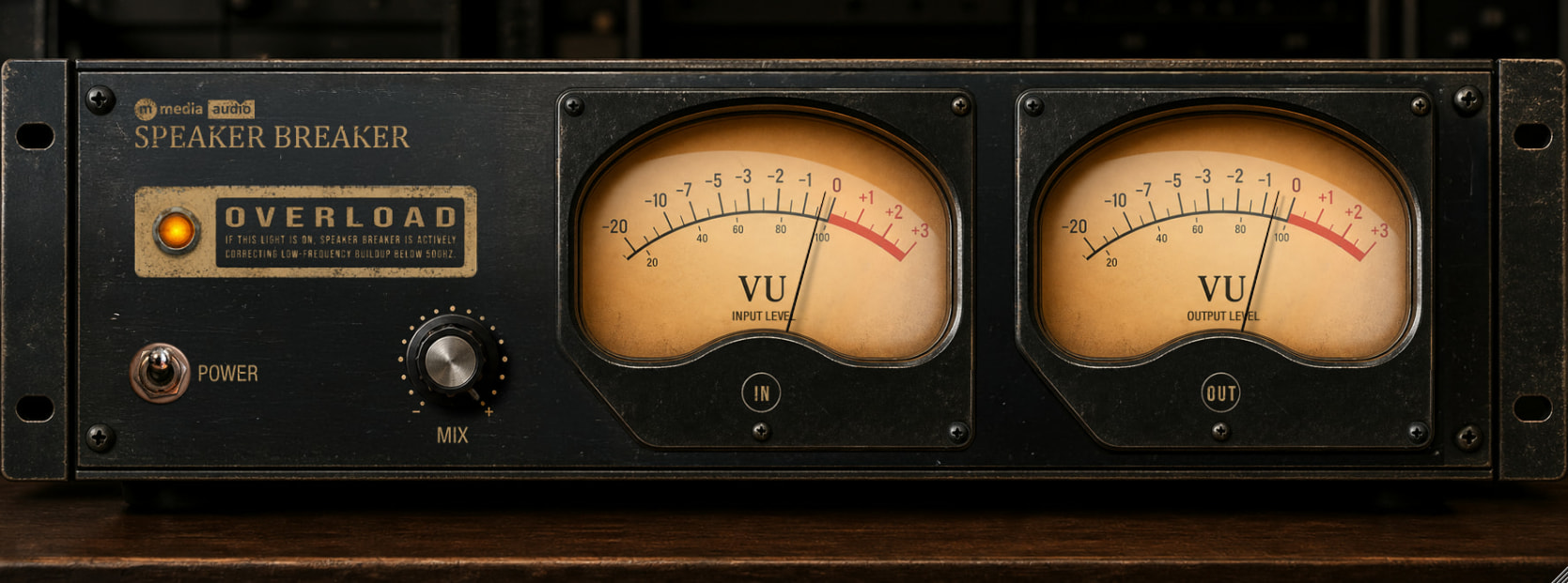
Speaker Breaker is a dynamic low-end correction processor for everything below 500 Hz. It watches five key low-frequency zones: sub, kick, low bass, upper bass, and low-mid boxiness. When those areas start building up beyond practical translation targets, it applies smooth gain reduction and blends the corrected signal back with the original.
This is not a bass-killer. It is a bass translator. The goal is not to make the mix smaller. The goal is to make the low end behave consistently when it leaves the studio.
That distinction matters. A mix can sound massive in one room and collapse everywhere else. Sub can feel impressive on large monitors but vanish on small systems. Upper bass can feel warm in the studio and muddy in the car. Low mids can make a track seem powerful until the vocal disappears behind a wall of cardboard.
Speaker Breaker gives the low end a reality check. Drop it on a mix bus, drum bus, bass bus, or 2-bus, start with the Mix knob at its default position, and watch the meters. If the overload light comes on, the plugin is correcting buildup. If it stays dark, the low end is already under control. For once, the warning light is not a crisis. It is the adult in the room.
Velvet Crush: Smooth the Top Without Dulling the Song
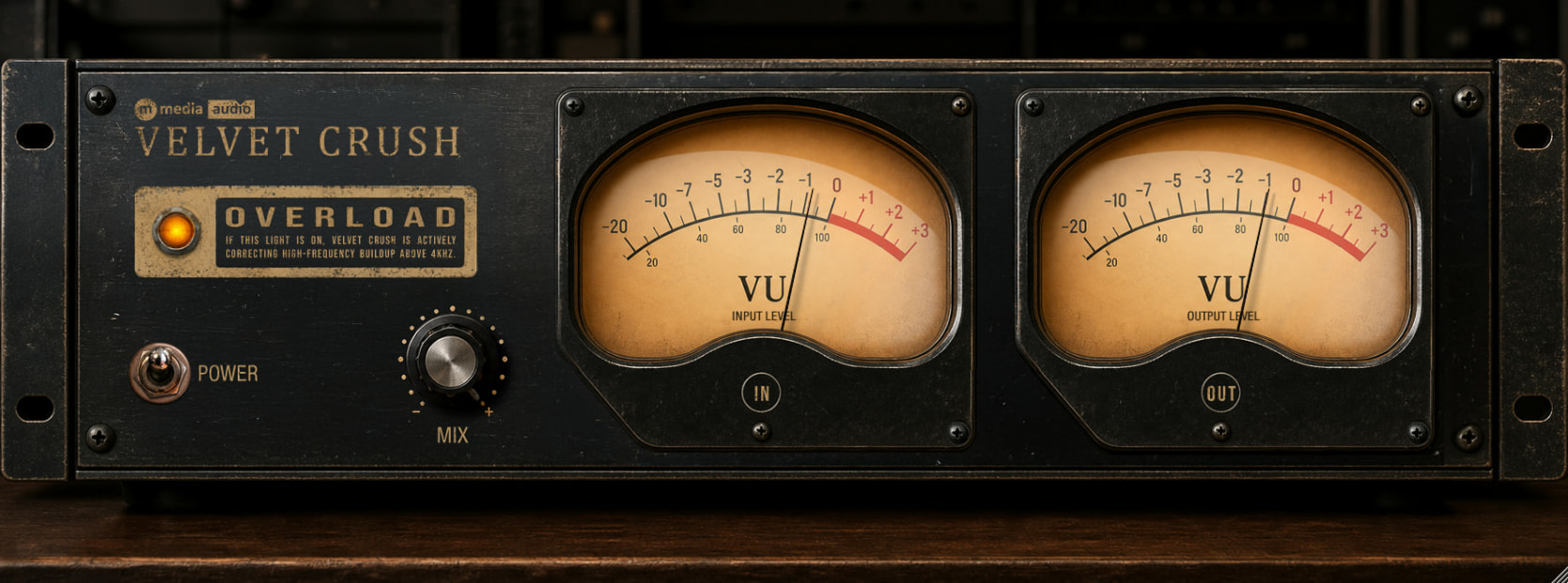
Velvet Crush is the high-end counterpart. It focuses on everything above 4 kHz and watches six zones where harshness and fatigue tend to accumulate: presence, edge, clarity, sparkle, air, and ultra-high content. Modern mixes often fail at the top for the same reason they fail at the bottom: the studio tells a flattering story. A bright vocal can sound expensive on monitors and brutal in earbuds. Cymbals can feel open until streaming compression turns them sharp. Synths can carry a beautiful sheen that becomes glassy on consumer playback.
Velvet Crush reduces harsh peaks and accumulated brightness dynamically. It does not add shine. It does not roll everything off. It preserves air by removing the parts of the high end that make the listener tired. The goal is the name: velvet. Smooth, controlled, extended, and listenable. Not dull. Not dark. Not “fixed” in a way that makes the mix smaller. Just less painful where pain was never the point.
A Simple Chain with a Lot of Practical Use
Together, the three plugins cover a surprisingly large amount of practical mix-finishing territory. Speaker Breaker handles the low-end translation problem. Velvet Crush handles the high-end fatigue problem. Alternate Timeline handles the broader mastering identity problem. A simple workflow might look like this: use Speaker Breaker to make sure the bottom end is not overloading the mix, use Velvet Crush to keep the top end smooth and listenable, then use Alternate Timeline to give the final presentation an era-based mastering contour. That does not mean every track needs all three. It means the tools are designed to stack logically when the mix calls for it.
For a dense electronic track, Speaker Breaker can keep the kick and bass from crowding the low end while Velvet Crush manages bright synths, hats, and upper harmonics. Alternate Timeline can then pull the whole thing toward a Modern or 2000s presentation. For an indie rock mix, Speaker Breaker can clean up bass and low-mid buildup, Velvet Crush can tame cymbal edge and vocal bite, and Alternate Timeline can lean the track toward a 1990s-style master with clarity, weight, and breathing room. For older-style material, Alternate Timeline can establish the decade character first, while Speaker Breaker and Velvet Crush can be used more gently to solve translation problems without destroying the intended personality of the mix.
Focused Tools Beat Bloated Tools
These plugins are not trying to replace engineering judgment. They are trying to reduce the amount of time engineers spend fighting the same predictable problems. Low end lies. High end punishes. Era character is hard to describe until it is missing. Those are the problems these tools are built around.
Speaker Breaker does not need to be a full-spectrum processor. Velvet Crush does not need to touch the low end. Alternate Timeline does not need to pretend every decade is just an EQ curve. Each plugin has a clear job, and that is why the workflow stays fast. All three are Windows VST3 processors designed for practical production work. They are built for producers, mixers, and mastering-minded creators who want tools that solve real problems without turning the session into a science fair. The point is not to own more plugins. The point is to finish better mixes.
Alternate Timeline gives the track a world. Speaker Breaker keeps the bottom from falling apart. Velvet Crush keeps the top from drawing blood.
That is a pretty good start.