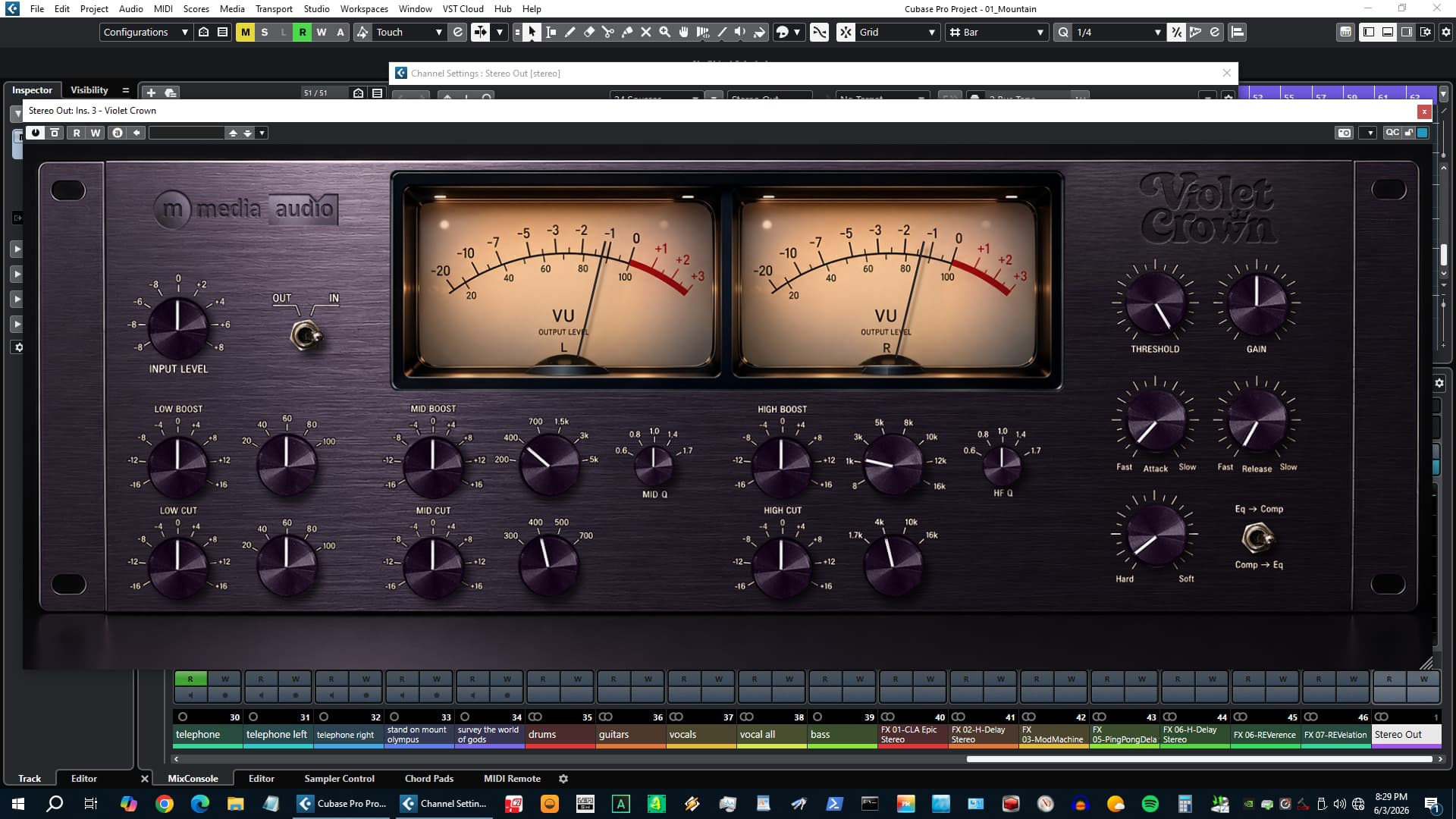
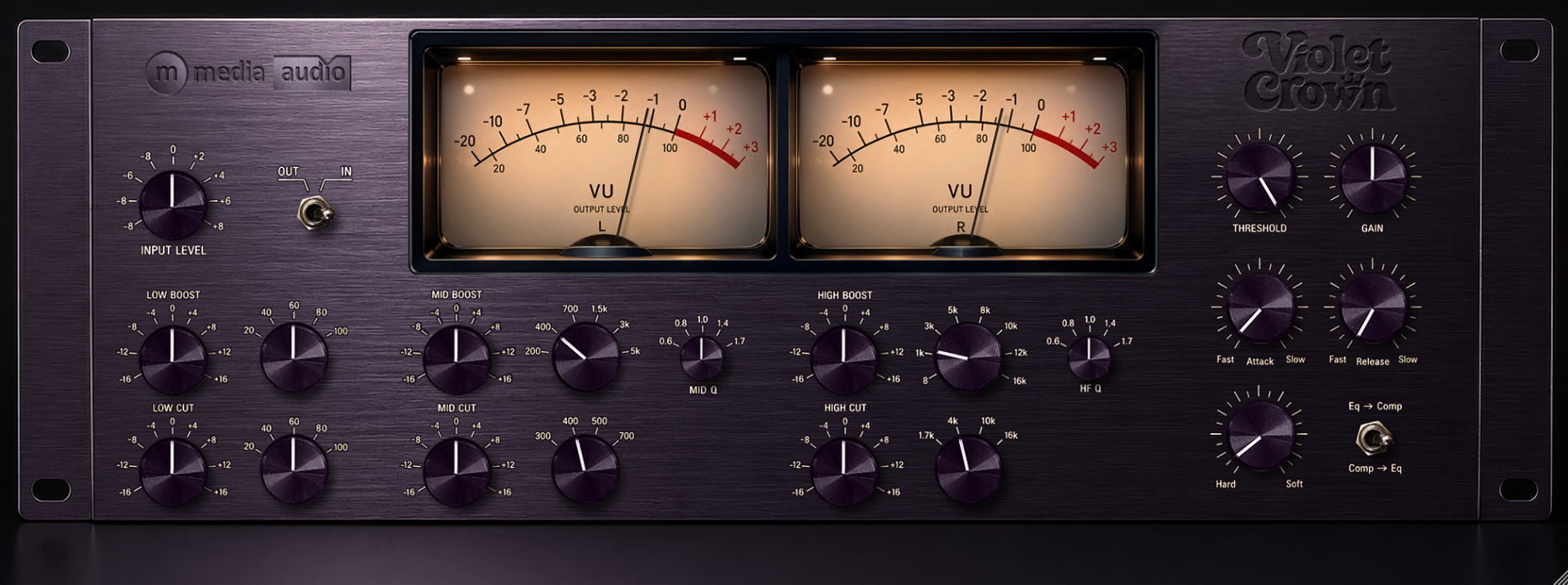
We have been building audio tools for over 35 years. We have also been watching the free plugin space long enough to know the difference between something genuinely given away and something deliberately crippled so you buy the upgrade. Violet Crown is the former. It is a full stereo channel strip – six independent EQ filters and a custom RMS bus compressor – with no demo mode, no activation, no expiration, and no catch. Download it and it is yours.
The reasoning is simple. The tools that shaped how we think about audio were not the expensive ones. They were the ones somebody just handed us. We wanted to put something real into that tradition.
What It Actually Does
Violet Crown is a channel strip built around EQ and bus compression character. Three independent EQ bands, each with a separate boost and cut control – six filters total, none sharing anything they do not need to share. That means you can stack two different operations on the same band, or cover two independent frequency points without spending a second band on it. Low band runs from 20 to 100 Hz on both filters. Mid runs 200 Hz to 5 kHz with a shared Q. High runs 800 Hz to 16 kHz. An input level trim sits pre-EQ, and a routing toggle on the right panel lets you run EQ-first or comp-first depending on what the signal needs.
The compressor section uses RMS detection with per-channel independent processing. RMS hears the body of the program – not just its loudest transient. The auto-release mode adapts continuously: fast when the compressor is working hard so it does not pump, slow when it is barely touching so it does not breathe audibly. Threshold, ratio from 1.5:1 to 8:1, attack from 1 to 200 ms. The VU meters show left and right output independently with 300 ms ballistic response. When the needles move together, the image is holding.
The Linux Part
Windows and macOS were not the hard part. Linux was the hard part, and we shipped it anyway because we use it and our users use it.
The first lesson was Ubuntu 22.04 removing libwebkit2gtk-4.0-dev from the standard package list. It is not needed for audio plugins, but the standard JUCE build documentation assumed it was present, and the build system would silently fail in ways that were not immediately obvious. Once we stripped the dependency list down to what an audio plugin actually needs – libgtk-3-dev, libcurl4-openssl-dev, the ALSA headers, libasound2-dev – the Linux builds cleaned up immediately and have been solid since.
The CI pipeline runs on GitHub Actions across Windows, macOS, and Linux runners simultaneously. Each platform builds independently, the artifacts get collected, and the whole thing gets packaged into a single zip. That cross-platform CI process was more work to set up than writing the DSP. But it means every release is tested across all three platforms before anything ships. Violet Crown was the plugin that proved the pipeline worked end to end.
macOS has its own tax. Apple requires code signing and notarization for anything that will run without security warnings on modern systems. That means a Developer ID certificate, a notary key, a provisioning profile, a stapled notarization ticket, and a Gatekeeper-compliant bundle structure. None of it is optional. The Violet Crown release was the first time we ran the full macOS notarization workflow through CI without a human touching the machine, and getting it right took several iterations. It works cleanly now. Every plugin that ships after Violet Crown inherits that infrastructure.
No Strings
Violet Crown has no license server because it does not need one. No activation code, no online check, no internet connection required, ever. Install it, drop it on a bus, use it for the rest of your career. If you are running Reaper on a headless Linux box in a server rack somewhere, it will work there too.
Windows, macOS Universal Binary (Intel and Apple Silicon), and Linux in one download. If you run into anything, email us directly – support@mmediaaudio.com. There is no ticket system.