We built Sugar Engine because the question we hear most often is not “what compressor should I use” or “do I need a de-esser” or “how do I double the voacal” – it is “what do I put on my vocal?” Those are four different questions. Sugar Engine is the answer to all of them at once.
The Problem With Building a Vocal Chain
A proper vocal chain takes real thought to assemble. You need a compressor that breathes instead of grips – opto character, not VCA. You need EQ that handles the full vocal frequency range without surgical guesswork on the broad strokes. You need de-essing that distinguishes between sustained sibilance and hard consonant transients, because those are different problems that sit at different frequencies and arrive at different speeds. And if you want the vocal to sit wide and full in the mix without recording a second take, you need a doubler that actually sounds like a second take and not like chorus.
Four plugins. Four instances. Four sets of settings to remember and rebuild next session.
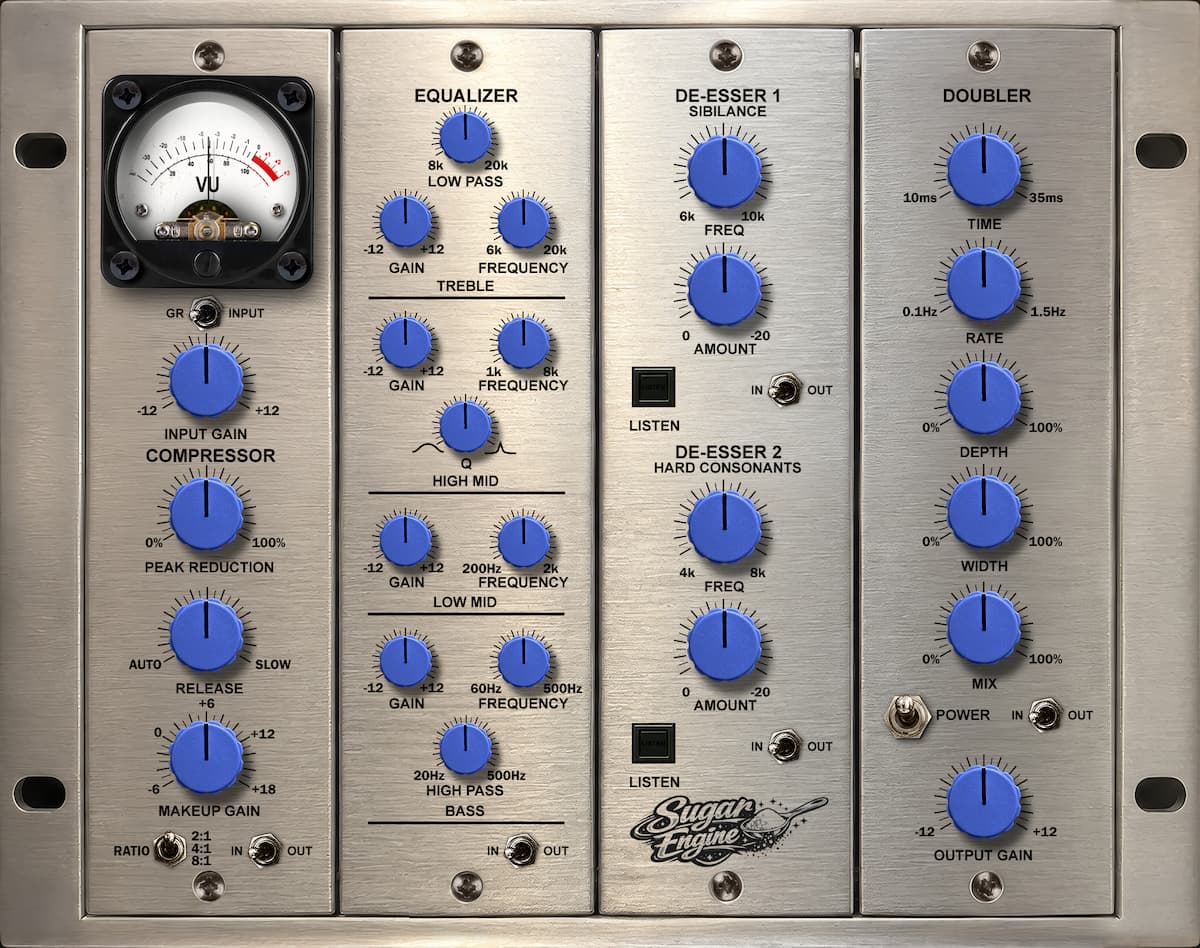
Sugar Engine is one plugin. One insert. Four stages, each independently bypassable, in a fixed order that reflects the correct signal flow: compress first, then shape the tone, then address the harshness, then widen if the track needs it.
What Is in the Box
The compressor uses opto gain-reduction character – a two-stage photocell release that holds compression longer when it’s working harder and lets go smoothly when the signal backs off. Peak Reduction is a single control that combines threshold and input drive. More reduction, more compression. No math. Auto Release adapts to the performance in real time.
The parametric EQ covers six bands across the full vocal range, from HPF through a fully parametric mid band with adjustable Q to LPF at the top. The mid band is the surgical one. The rest are set for musical, broad-stroke tonal shaping – the kind of moves that make a vocal sit in a mix rather than fight it.
The dual de-esser is the part of Sugar Engine that most plugins don’t have at all. De-esser 1 handles sustained sibilance – the S sounds that linger in the 6-10 kHz range. De-esser 2 targets hard consonants: T, K, and CH sounds that are transient, lower in frequency, and faster than a conventional de-esser’s detector can catch. Both have a Listen button so you can find the exact problem frequency before setting the reduction amount.
The doubler is a short delay with slow chorus modulation on the delayed signal only. The rate range stops at 1.5 Hz by design – fast enough to drift naturally, too slow to cross into chorus territory. The result sounds like a second take. Not pitch modulation. Not shimmer. A second performance.
Studio and Live
Sugar Engine runs at plugin latency with no oversampling. Every stage processes in real time without the delay penalty that makes heavy vocal chains impractical for live use. The settings you dial in during tracking are the same settings you use in the mix. There is no version of this plugin for the studio and a different one for live – there is one plugin, and it works everywhere you need it.
Available Now
Sugar Engine is $49 perpetual. Three activations. Windows, macOS (VST3 and AU, Apple Silicon and Intel), and Linux. The free demo includes the full DSP – it silences briefly every 30 seconds. No account required to try it.