Anaheim

Dual-Channel Tube Mic Pre and Compressor.
Vari-Mu Glue, Built-In EQ, One Insert.

$29 Perpetual License
3 Platforms
VST3 + AU on macOS
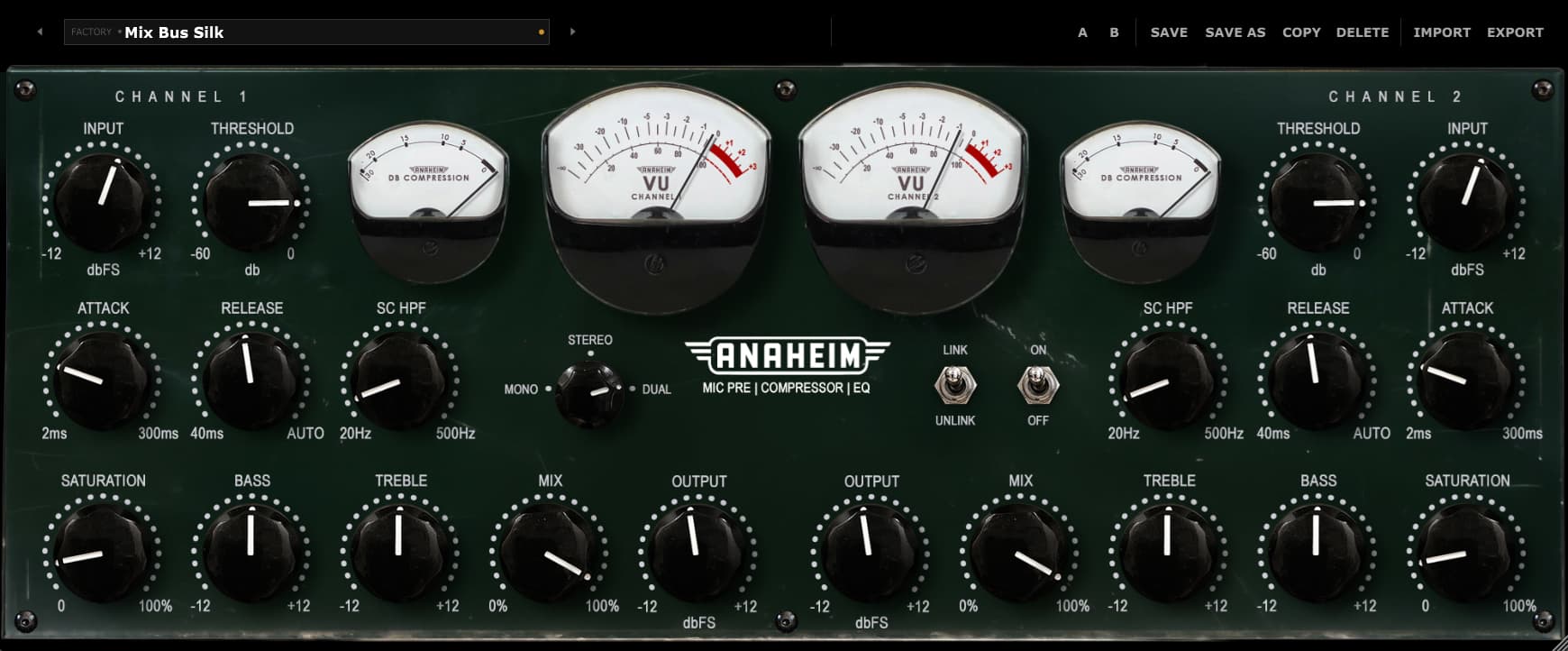
Anaheim VST3 - Dual-Channel Tube Mic Pre and Compressor Interface

Anaheim

Perpetual license - pay once, own it forever.

$29 Buy Now

Secure checkout · Instant license delivery

Try the free demo
Anaheim VST3 - Dual-Channel Tube Mic Pre and Compressor Interface
Demo

Watch Anaheim In Action

A Mic Pre, a Compressor, and an EQ. One Insert.

Anaheim is a dual-channel tube mic pre and compressor with a beefy Vari-Mu gain stage and a built-in 2-band EQ, all in one insert. The Input knob drives the initial tube stage, so it adds character before you've touched another control at its base setting, like a real preamp does, it just automatically adds color.

From there the signal hits the Vari-Mu compressor, it really breathes and holds the material instead of just controlling peaks, it's an instant thickening and smoothing agent. Threshold, Attack, Release, a sidechain high-pass is the entire story. You don't want to modify the input gain again so the Saturation stage sits right after the compressor for exactly that. A simple Bass/Treble EQ closes out the chain, Bass is a low shelf at 80 Hz, Treble is a high shelf at 8 kHz, then Mix blends it all back against the dry signal, that's New York-style parallel compression.

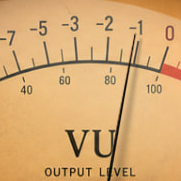
VU meter

Load Mix Bus Silk. Push the Input.

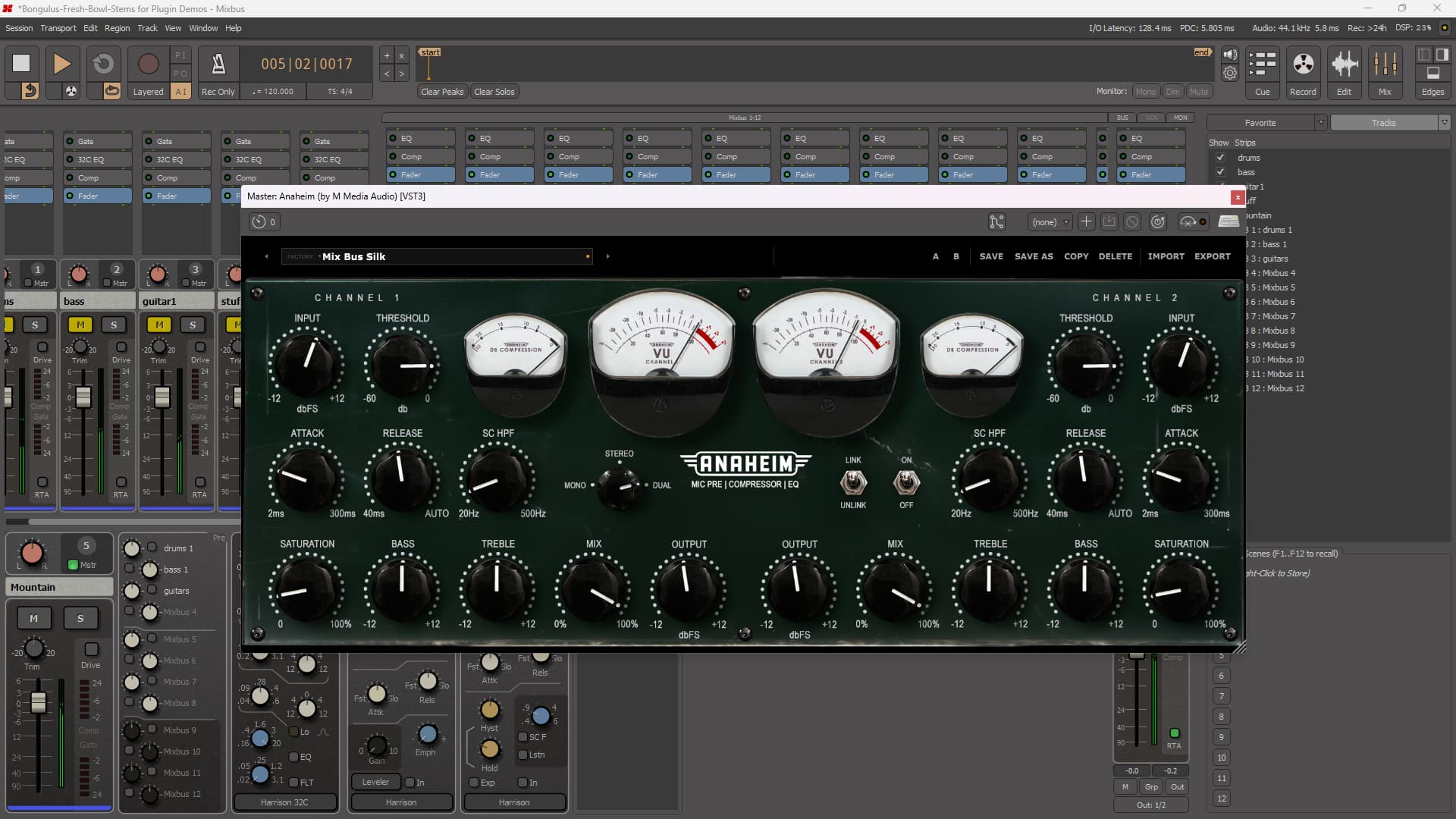
Drop it on a 2-bus, load the Mix Bus Silk preset, and listen to the Vari-Mu stage take hold. Then push the Input past noon and hear the tube stage wake up on its own, no drive knob to find.

Try Anaheim Free

No account required - we send the link to your email. Silences briefly every 30 seconds in demo mode.

Vari-Mu Compression

Threshold, Attack, Release, a Sidechain High-Pass. That's the Whole Story.

Anaheim's compressor is a real Vari-Mu gain stage, gain reduction that breathes with the material instead of just stomping on peaks. There's no Ratio knob to second-guess, the ratio is fixed and inherent to the topology, so the compressor was tuned to sound right without asking you to consult a manual first. The sidechain high-pass keeps low end from driving the gain reduction on anything bass-heavy, and Release runs all the way to Auto for program-dependent recovery.

  • Threshold - -60 to 0 dB, fully open at rest
  • Attack / Release - 2ms to 300ms attack, 40ms up to Auto release
  • SC HPF - 20Hz to 500Hz, sidechain only, audio path untouched
  • Fixed ratio - No Ratio knob. One less decision, tuned to sound right
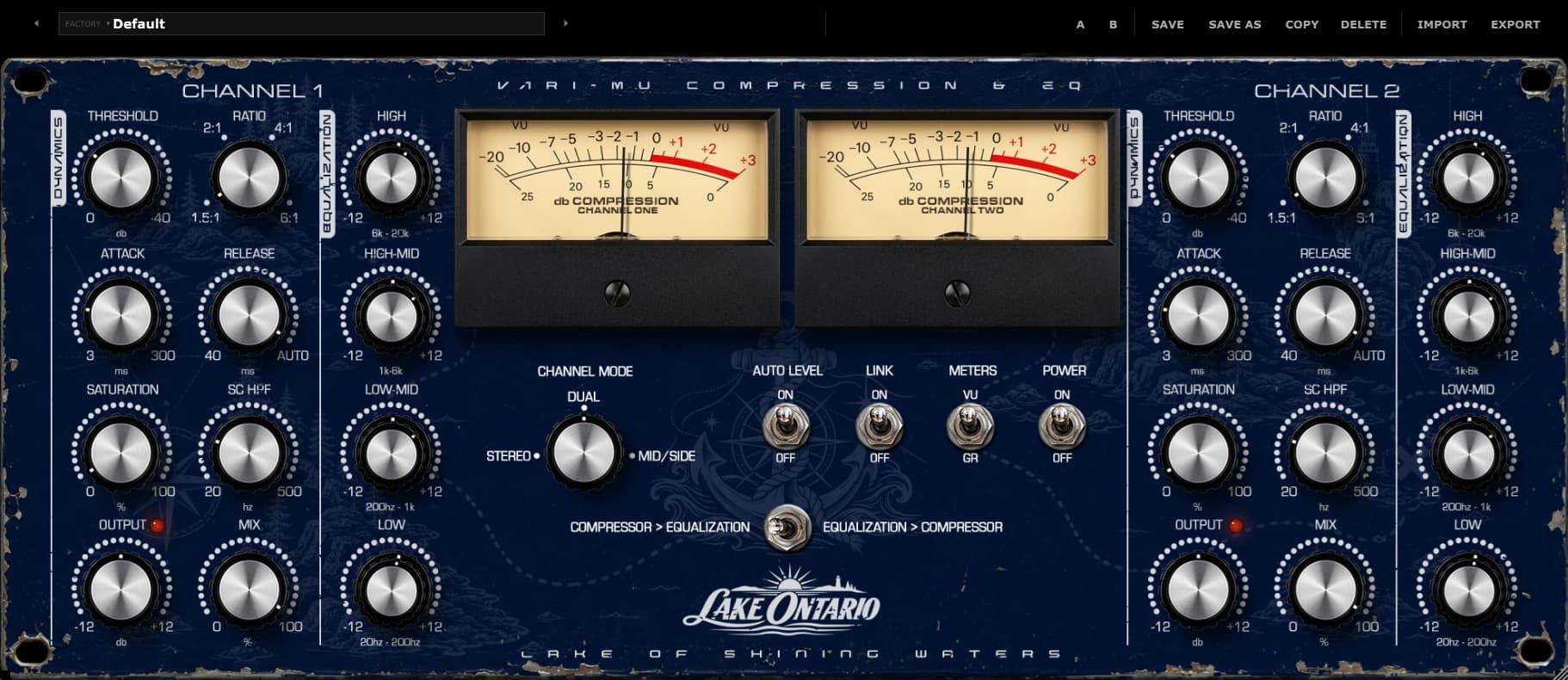
Anaheim Vari-Mu compressor controls, Channel 1
Anaheim tube Input drive and Saturation stage, Channel 2

Tube Input, Then Saturation

Two Places to Add Grit. Neither One Asks Permission.

The Input knob isn't just level, it drives a tube stage automatically, so pushing it adds color before you've touched anything else, the way driving a real preamp does. Once the signal's through the compressor, a second Saturation stage sits right after it for whenever you want more grit than the input drive alone gives you, without having to go back and re-touch Input.

Two separate places in the chain to add character, one before compression, one after, each doing a different job instead of one knob trying to cover both.

  • Input - -12 to +12 dBFS, tube-driven trim into the compressor
  • Saturation - 0 to 100%, tube stage after compression, second-harmonic character
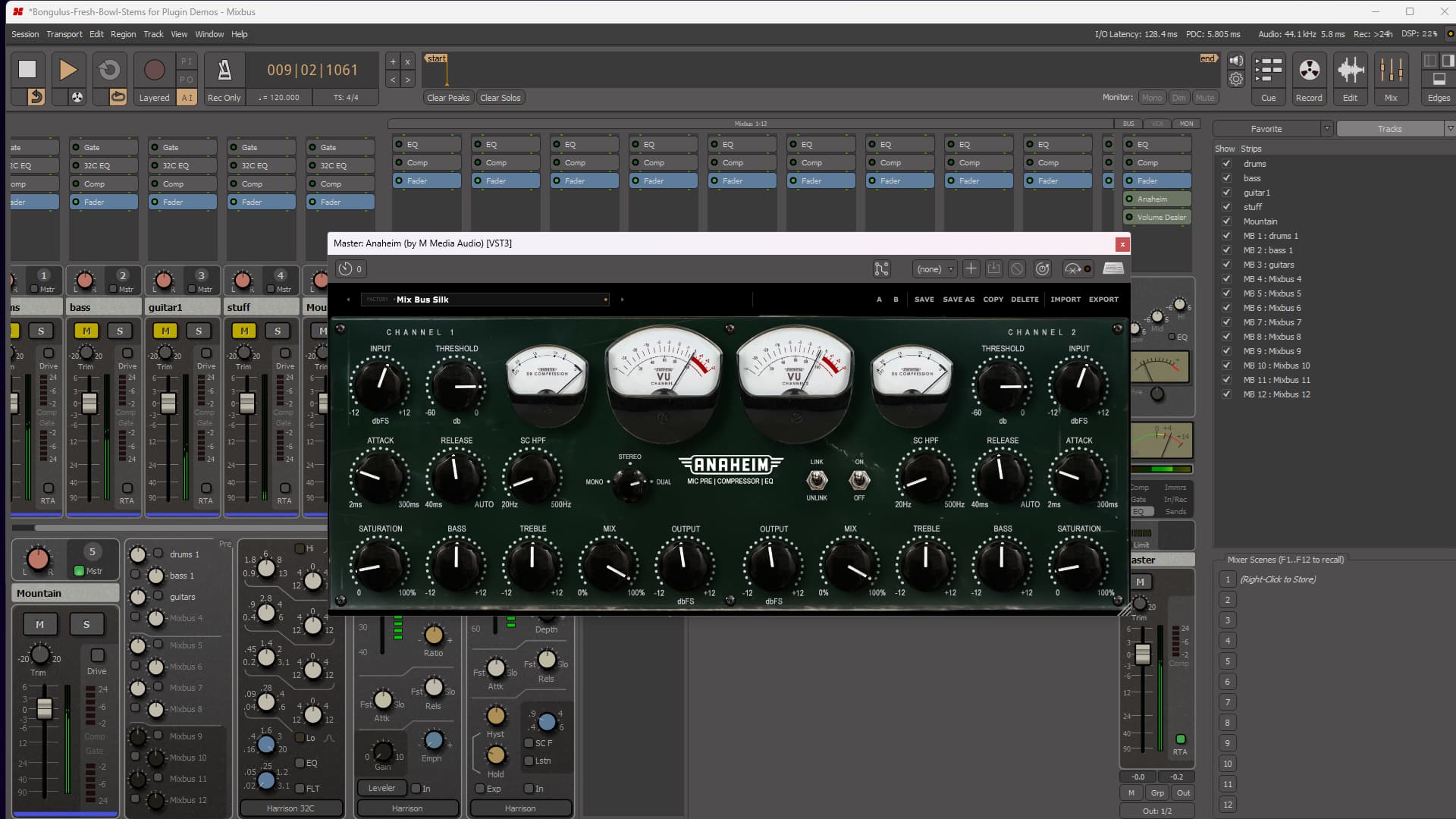
Anaheim VST3 loaded in a real mix session

Bass / Treble EQ and Mix

Simple on Purpose. Shelving, Not Parametric.

A simple Bass/Treble EQ closes out the chain after compression and saturation. Bass is a low shelf at 80 Hz, Treble is a high shelf at 8 kHz, both shelving, not surgical, because by the time the signal reaches the EQ it's already been shaped, this stage is for broad tone, not correction. Mix blends the whole processed chain back against the dry signal, that's New York-style parallel compression, dial it back from 100% whenever you want the character without giving up the original transient.

Anaheim Stereo Mono Dual channel mode selector and Link switch

Channel Mode and Link

Dual Channel, Matched Stereo, or Mono. One Switch.

Both channels get every control, independently, and a three-way Stereo/Mono/Dual switch plus a Link toggle take you from a dual channel setup, to a matched stereo pair, to mono. Dual channel makes things huge, it's perfect for 2-bus mixing but great for drums, bass, guitars, vocals, and more, it really sounds like the old units. Stereo gangs Channel 1's controls onto both sides for a matched pair, Mono sums to a single path for a source that needs to sit dead center.

Link works independently of the mode switch, engage it and Channel 1's controls drive Channel 2 directly, useful any time you want two sources handled identically without switching out of Dual mode.

Metering

A Compression Meter and a VU Meter. Per Channel.

Each channel gets its own dedicated compression meter and its own output VU, four needles total, so you're never guessing what it's actually doing. The compression meters read 0 to -20 dB, needle rests at 0 and swings down as gain reduction builds. The VU meters read standard M Media ballistics on post-chain output level, the same needles you'd expect on any of the channel strips in the catalog.

  • Compression meter - Per channel, 0 to -20 dB, rests at 0
  • Output VU - Per channel, standard analog-calibrated ballistics
  • Always visible - No shared meter-source switch, both readouts live at once
Anaheim compression meters and VU meters
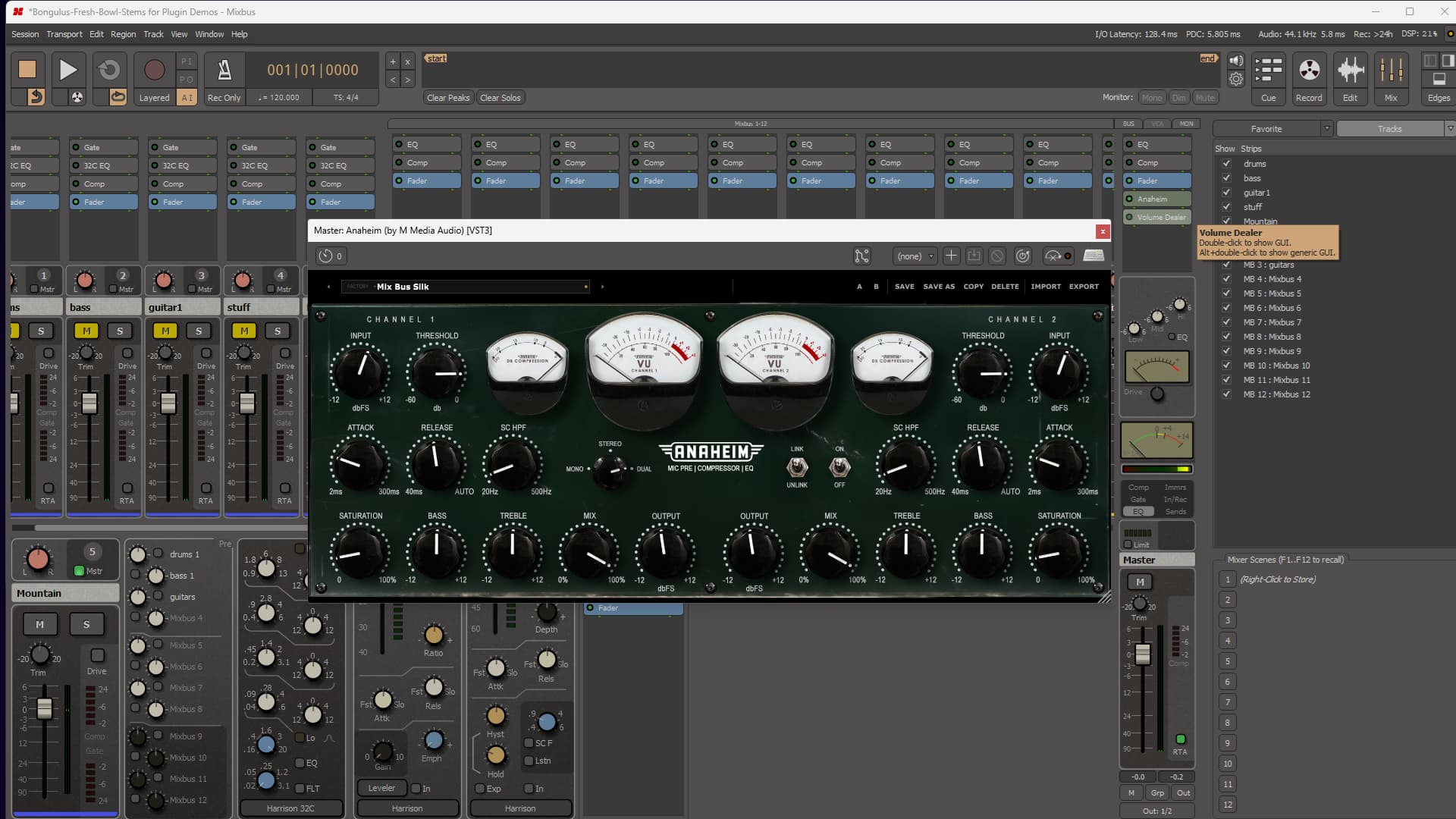
Anaheim VST3 running on a mix bus
Anaheim factory presets in session

Ten Factory Presets

Ten Presets, and There's Plenty More Underneath.

Ten factory presets get you into character fast, from a clean starting point through to fully driven. Load one close to what the track needs and move from there, every control's still live underneath so nothing's locked once you're in a preset.

  • Flat - Init state, all controls at unity, Dual mode
  • Vocal Warmth - Gentle glue for lead vocals
  • Drum Bus Glue - Punchy bus compression, faster attack
  • Mix Bus Silk - Slow glue across a full mix bus
  • Broadcast Voice - Mono mode, presence-forward voice processing
  • Mastering Touch - Ultra-gentle, Stereo mode
  • Parallel Punch - Low mix, hard and fast, New York-style
  • Tube Push - Saturation-forward, driven hard
  • Bass Tighten - Fast, controlled low end
  • Air & Sheen - Treble-forward, light touch

Perpetual License

One-time purchase. Yours forever. No subscription, no renewal.

3 Activations

Install on up to three machines simultaneously. Need to move a license? Email us.

🔒

Secure & Private

Encrypted activation over HTTPS. No telemetry. No data leaves your machine during use.

Direct Support

You email us, we answer. No ticket queues, no bots, no knowledge base rabbit holes.

System Requirements

Format

VST3 (64-bit) - Windows, macOS, Linux
AU (64-bit) - macOS only

Platform

Windows 10 / 11
macOS 11 Big Sur or later (Apple Silicon + Intel)
Linux - Ubuntu 22.04+ or equivalent

DAW Compatibility

Any VST3-compatible host: Reaper, Cubase, Studio One, Ableton Live, FL Studio, Bitwig Studio, Nuendo, and more

AU (macOS): Logic Pro, GarageBand, MainStage

License

Perpetual, single user
3 simultaneous activations
Need to move a license? Email us

SHA-256 (mmedia-anaheim-v1.0.1.zip): 8dbbbb7e31d5107daa790fd7f7f358ef8edd2041d61a8e1a08b9f5beea3e57e1

Linux System Requirements

Tested on Ubuntu 22.04/24.04, Debian 12, Fedora 40. Requires one system library for license verification:

sudo apt install libsodium23        # Ubuntu / Debian
sudo dnf install libsodium          # Fedora / RHEL
sudo pacman -S libsodium            # Arch

VST3 only. Confirmed working in REAPER and Bitwig.

Anaheim

Perpetual license - pay once, own it forever.

$29 Buy Now

Secure checkout · Instant license delivery

Try the free demo
From the Industry

Pro Audio