A drum transient can have a very tall peak and a relatively short life. Sometimes that peak is essential to the groove. Sometimes a small portion consumes headroom without contributing much to the impression of punch.
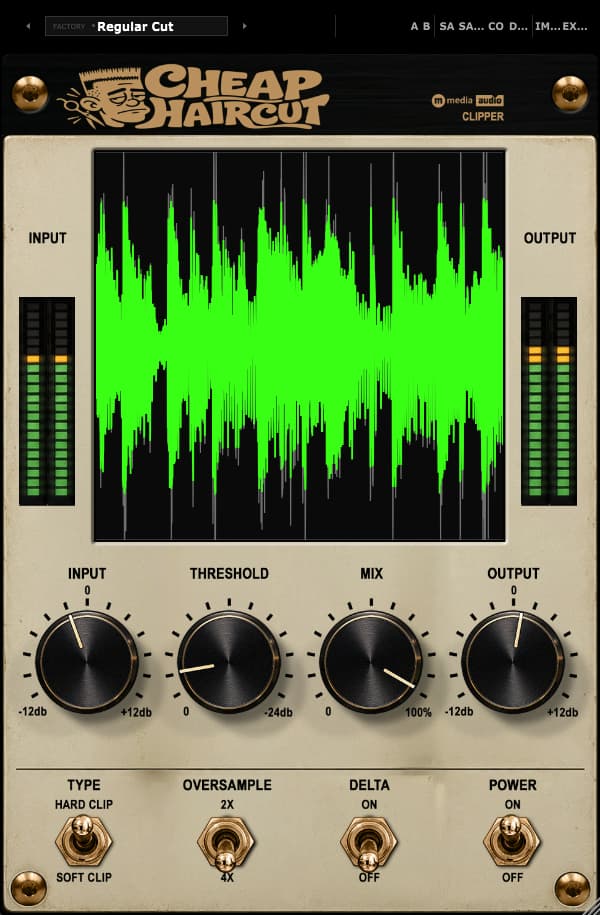
A clipper lets you experiment with that distinction. Cheap Haircut provides hard and soft clipping, a parallel Mix control, oversampling and a live scope so you can connect the sound to the shape being changed.
Clipping Changes the Waveform
Hard clipping places a sharp boundary on amplitude. Samples exceeding that boundary are limited to it, changing the waveform and creating additional harmonic content. Soft clipping rounds the transition near the boundary, producing a different balance of density and edge.
Neither is the same as a compressor with attack and release. A compressor changes gain according to an envelope; clipping changes the amplitude shape directly. That is why a small cut can preserve a sense of urgency, while a large cut can become an obvious distortion effect.
On drums, the benefit may be a more immediate snare, denser kick or a bus that needs less peak control from the next limiter. The cost may be less transient contrast and a rougher cymbal texture.
Begin With a Small Haircut
Insert Cheap Haircut before the final bus limiter, if you use one. Start with modest Input and a high Threshold. Play the hardest section and lower Threshold until the scope shows only the tallest excursions being trimmed.
The grey trace shows the original waveform and fluorescent green shows the output. Use that comparison to locate the action, then listen without staring at it. A flattering waveform is not an audio format.
Compare Hard and Soft at similar output loudness, using a downstream gain trim if necessary. Enable Oversample and re-evaluate the sound; oversampling can reduce aliasing from nonlinear processing, but it cannot turn an excessive cut into an invisible one.
Parallel Mix Changes the Peak Outcome
Pulling back Mix can return some original attack while retaining clipped density. That can be excellent for character, but the dry contribution also brings back peaks. A parallel blend is not a guaranteed clipping ceiling.
Delta helps you audition what has changed. Return frequently to the complete kit and hear the cymbals, room decay and relationship between kick and snare.
When to Leave It Out
Skip clipping when the performance depends on delicate transient contrast, when the cymbals become grainy, or when the kick loses its depth before useful headroom appears. Also skip it when the level-matched bypass simply sounds better.
There is no prize for fitting every processor into a drum chain. Sometimes the best haircut is cancelling the appointment.