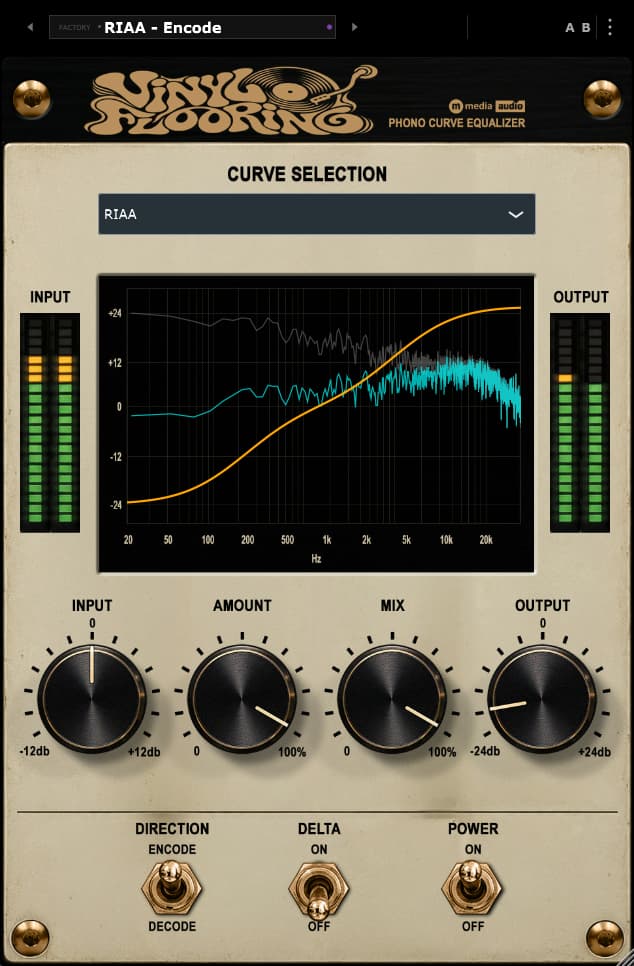
Record equalization is part of how a disc stores and reproduces music. During cutting, a defined frequency curve reduces bass relative to treble. During playback, its inverse restores the intended balance while also helping manage surface noise.
RIAA is the familiar standard, but historical discs used other curves. Vinyl Flooring provides RIAA, Columbia LP, NAB, AES and Decca/FFRR 1951, with Encode and Decode directions for each.
First, Identify Your Capture Path
If your turntable is connected through a conventional RIAA phono preamp, the playback correction is usually already present. Applying RIAA Decode again would duplicate that correction, producing an exaggerated tonal imbalance.
If you are capturing through a suitable flat, unequalized preamp, the recording still needs the appropriate playback curve. That is a straightforward use for Decode. A cartridge also needs suitable gain and loading; inserting software does not make an ordinary line input a proper phono front end.
Before changing anything, establish what the hardware has already done. The chain’s history matters more than whether the file sounds vaguely old.
Historical Transfers Need the Right Curve
For a disc made with another standard, selecting a curve by era alone is unreliable. Label, release date, pressing and available documentation can all matter. Different historical standards are not interchangeable flavours of RIAA.
If a transfer already passed through RIAA correction but needs another playback curve, you can theoretically undo that RIAA EQ with Encode and then apply the appropriate Decode curve in a second instance. This reverses the EQ response; it does not reverse clipping, noise, loading errors or other changes introduced during capture.
Keep an untouched capture and document the steps. Future you should not have to conduct an archaeological dig through unnamed inserts.
Amount and Mix Have Different Jobs
In Vinyl Flooring, Amount scales the selected curve from flat to full strength. Mix blends the processed audio with the dry audio afterward. Because the filtering is minimum-phase, a partial curve and a dry/wet blend are not equivalent operations.
For standard playback correction, start with Amount and Mix at full strength. Reduced settings are useful for creative shaping, but they no longer represent the full standard response.
The live curve and PRE/POST spectrum display show the operation; Delta lets you audition its difference.
Record EQ Is Not a Vinyl-Mastering Preset
Do not apply RIAA Encode to an ordinary master just because it will eventually be cut to vinyl. The cutting engineer normally manages that stage within the cutting system. Deliver the format requested by that engineer.
Use record EQ when the transfer or signal path actually calls for it. For creative experiments, enjoy the curves – with the paperwork labelled accordingly.