Useful sub-bass gives a record scale. Unnecessary energy below it can use headroom, influence dynamics and make playback systems work harder without making the music feel larger.
Before mastering, it is worth finding out which kind you have. That does not mean every mix needs a high-pass filter. It means the deepest part of the spectrum deserves the same deliberate attention as the vocal and the top end.
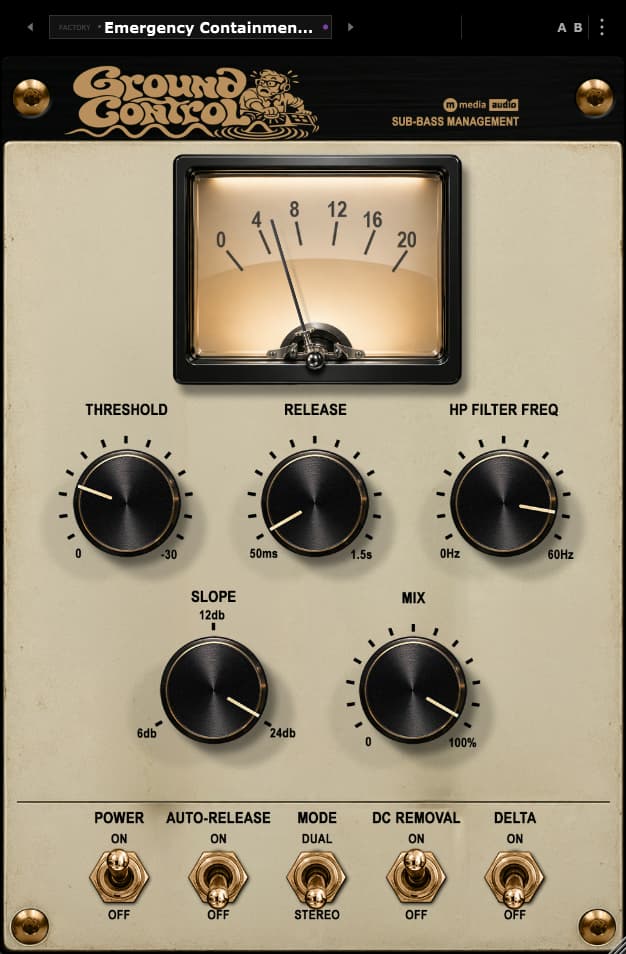
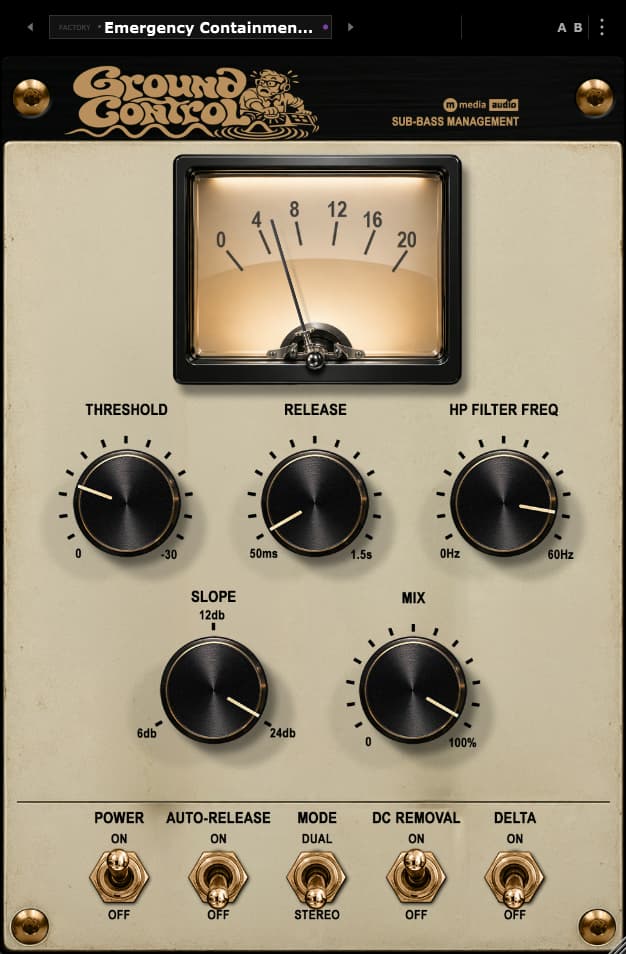
Ground Control offers three distinct tools for that job: DC Removal, a switchable high-pass filter and dynamic subsonic limiting.
Separate Offset, Rumble and Musical Bass
DC offset shifts a waveform away from zero. It is not a bass note, and removing it is a different operation from reshaping the audible low end. Ground Control’s independent DC Removal switch works before its filter and limiter.
Persistent rumble is another case: handling noise, transfer debris or low-frequency activity with no musical role. A static high-pass filter can be appropriate when that unwanted content is always there.
Musical sub-bass may behave well most of the time and become excessive only on particular notes or hits. For that, the dynamic limiter can intervene when needed and back off between events.
Filter Conservatively
The high-pass filter covers 5–60 Hz with 6, 12 or 24 dB-per-octave slopes, plus Off. Begin low and with a gentle slope. Raise the corner while listening to the deepest intentional note, then compare the entire mix.
A cutoff is not a vertical wall. Its slope and corner affect a region of the spectrum, so “below the fundamental” does not automatically mean “inaudible.” If the bass loses its scale or the kick becomes smaller, revisit the setting.
Let the Limiter Handle Exceptions
With the filter where you want it, set the subsonic limiter’s Threshold so it acts on the excursions you intend to control. Ground Control offers manual Release from 50 to 1500 ms and Auto-Release.
Listen to sustained bass as well as short kicks. Recovery that suits a brief hit may make a long synth note feel uneven. Use the reduction meter to see when intervention happens and Delta to hear the processing difference.
Stereo detection is a sensible first comparison on a full mix. Independent Dual treatment is available when the source calls for it, but check that it does not introduce unwanted image movement.
Judge What the Next Processor Gains
Place Ground Control before a mastering compressor or limiter and compare the chain’s behavior. Does the low end retain its authority while the next stage works more comfortably? That is a useful improvement.
The objective is a stronger foundation with intentional proportions. We are organising the basement, not demolishing it.