A record can be beautifully bright until one cymbal crash or consonant takes a step too far forward. Lowering a treble shelf addresses the entire passage, including the air and detail you wanted to keep.
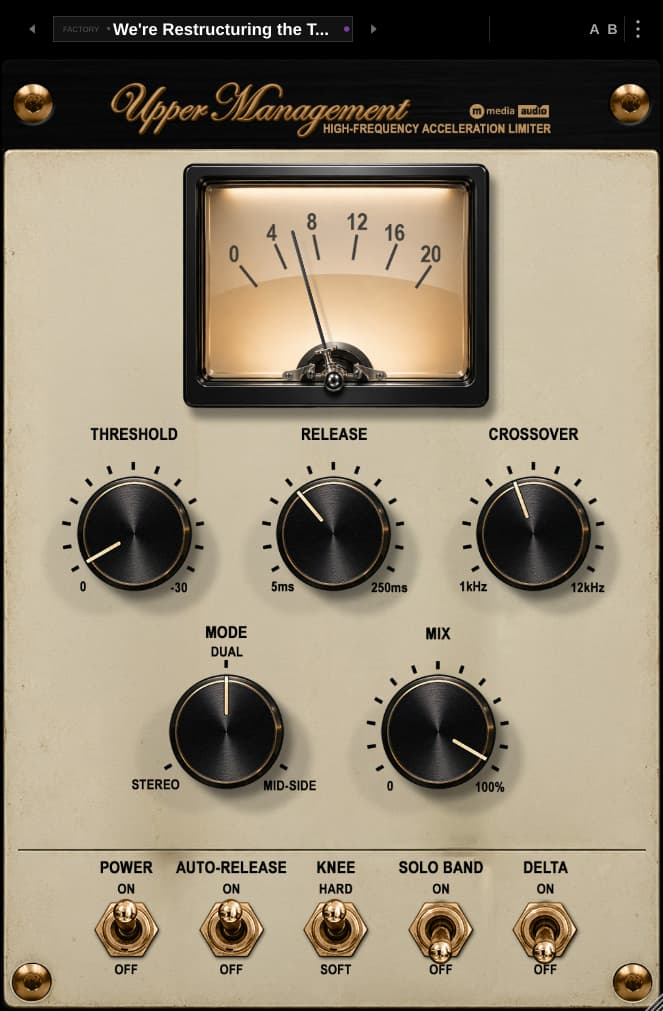
A high-frequency limiter offers a more selective approach: work on the upper band when its peaks cross the threshold. Upper Management applies that idea with an adjustable crossover, fast peak limiting and parallel blending.
Find the Region Before Setting the Amount
Upper Management’s Crossover runs from 1 to 12 kHz. It determines where the isolated high band begins. That is a substantial range: a lower setting can include upper-mid attack and presence, while a higher one concentrates on the upper treble.
Use Solo Band to listen to the chosen region. Move the crossover until the sound you want to control is clearly included. Also notice the desirable material in the same band. The processor cannot know which cymbal hit was artistically justified.
Return to the full mix before choosing how much to limit. A soloed upper band is useful evidence, but it is a poor place to judge a record’s overall brightness.
Let Threshold Decide When to Intervene
Begin with a high Threshold and lower it gradually through the loudest passage. Watch the gain-reduction meter, which represents the isolated high band rather than the entire mix.
For occasional control, aim for intervention on the events that stand out. If the meter shows continual reduction, decide whether that is a useful tonal treatment or whether a broad EQ adjustment would express your intention more directly.
Hard knee gives a firmer onset; Soft knee eases into the correction. Compare both against the rhythm and texture of the source.
Release Shapes the Recovery
Manual Release covers 5–250 ms, with Auto Release available. A faster recovery can keep the limiter ready for the next transient, while a longer one can smooth an extended splash. Excessively fast recovery may sound rough; excessive holding can make the top end retreat after a hit.
Mix blends the high-band treatment with the original contribution. This lets you soften the amount of control, although it also restores some uncorrected peaks.
Choose the Stereo Relationship
Stereo mode shares detection. Dual treats the channels independently. Mid-Side separates center and difference information before processing. Begin with shared Stereo detection on a full mix, then explore other modes for a specific reason.
Use Delta to hear the correction and Bypass to judge the complete result at comparable level. You should still hear the record’s openness and articulation, with the strongest events placed more comfortably inside it.
Finally, some useful upper management. No meeting invitation required.