10K Audio update Gyro
Gyro 1.2 introduces a Global Key Lock function that adapts newly loaded presets and chord sets around a user-selected key, new chord-generation tools that help to create fresh harmonic ideas,...
Get Ready to Rock. Two Independent Tape Machine Channels. Every Track Gets the Iron.
Free. No account, no activation, no expiry.
By downloading you agree to our EULA and Privacy Policy.
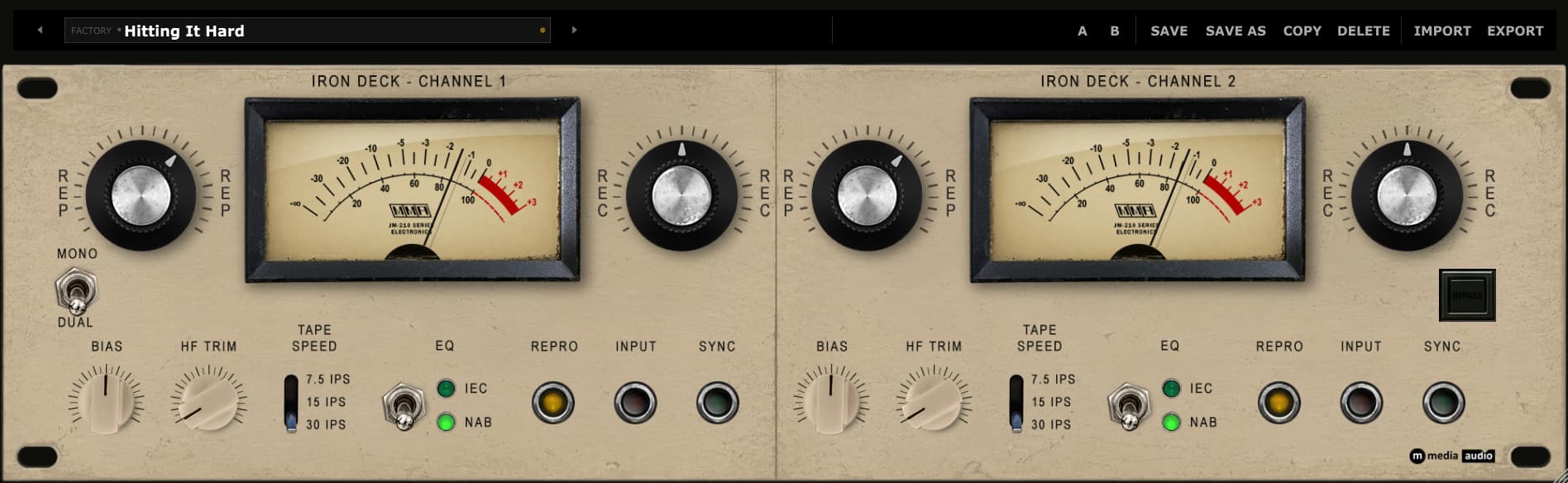
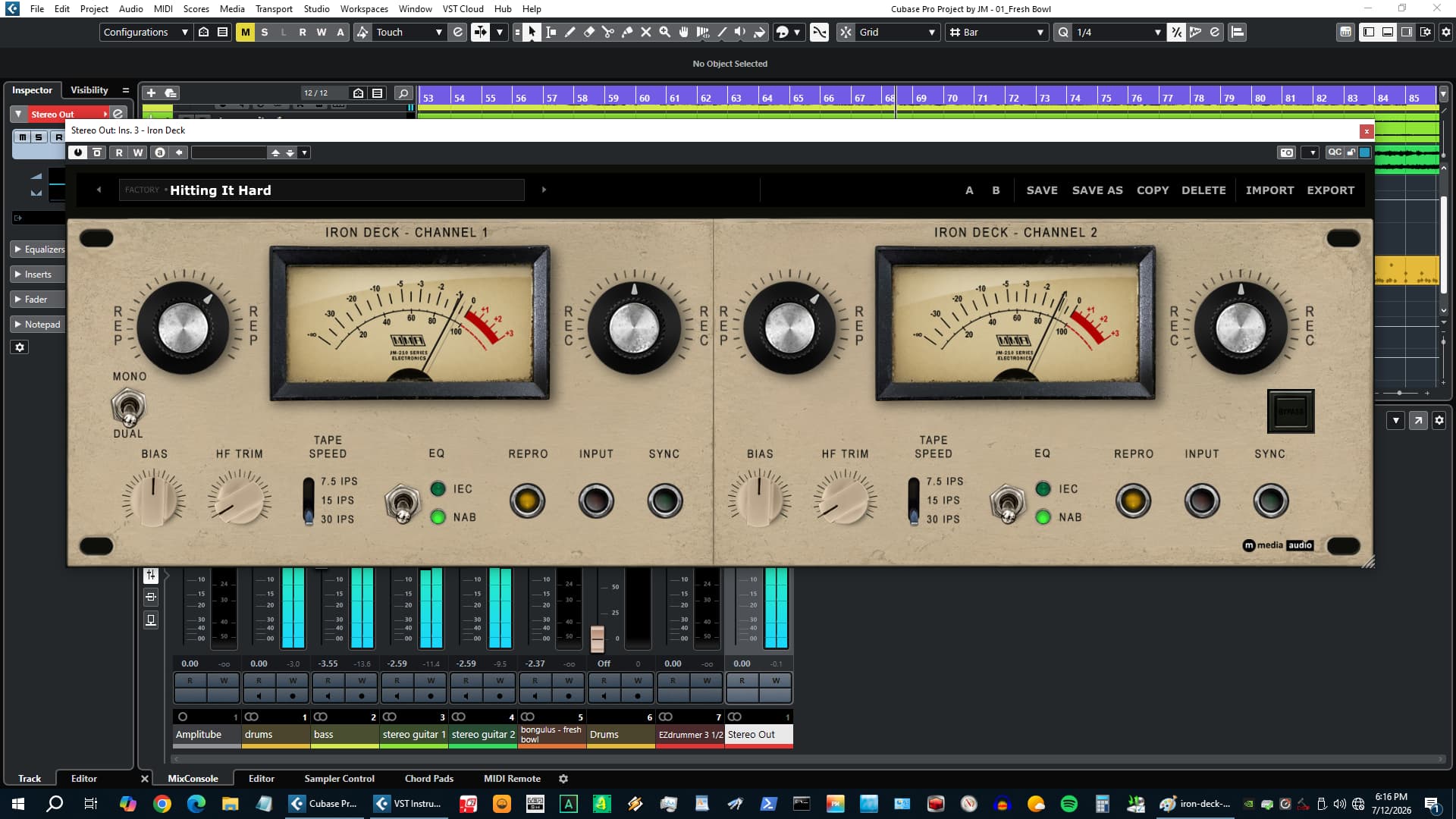
There is a quality to tracks that were recorded through real tape machines - not just warmth, but weight. Notes have a shape to them. Peaks round off in a way that sounds like physics instead of math. Transients breathe. The whole mix sits together without needing anything extra holding it down. That is what Iron Deck puts on a channel insert.
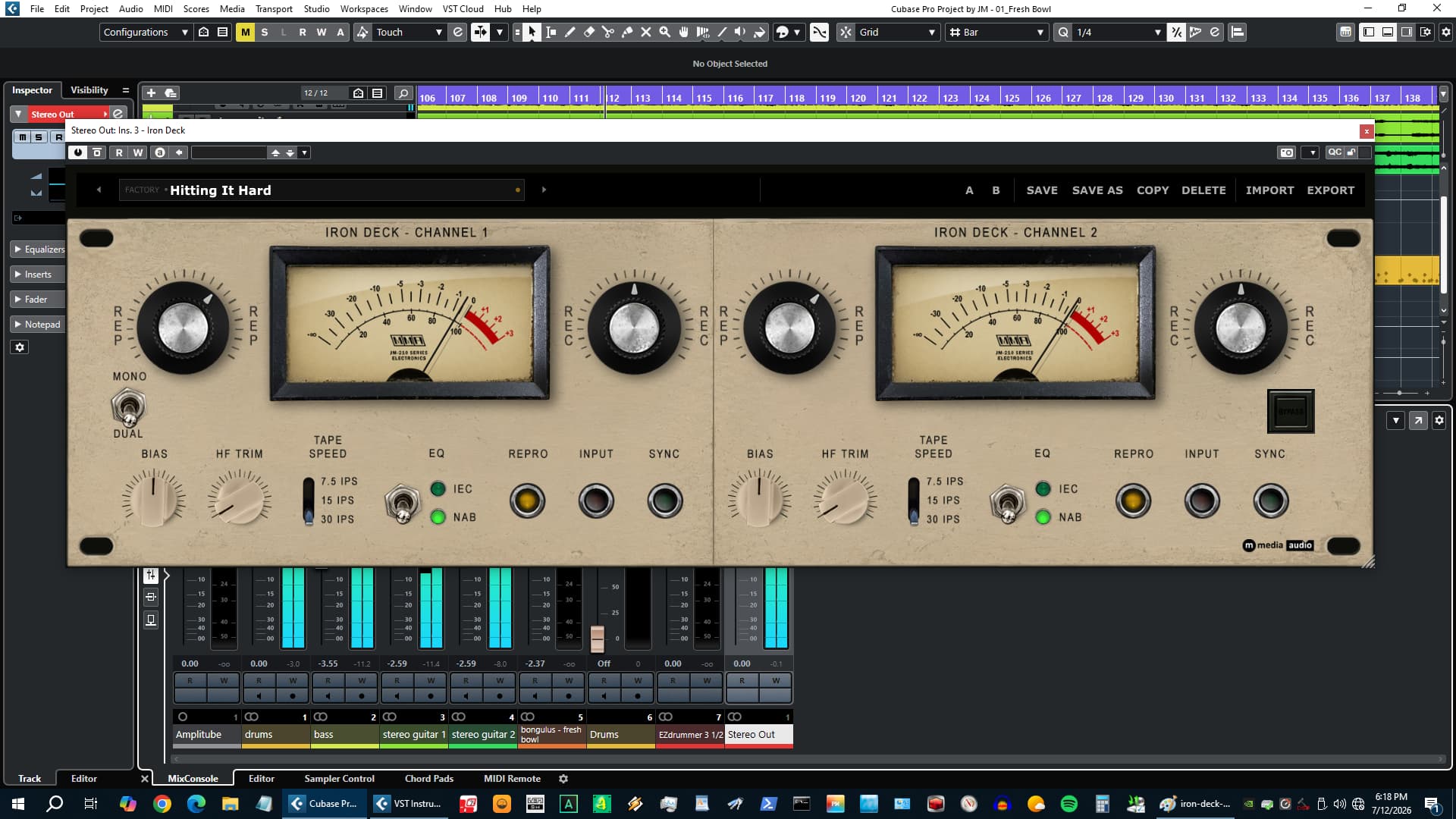
Two fully independent tape machine channels in one plugin. Each one runs a complete signal path: input drive into nonlinear tape saturation, RMS compression that acts exactly the way tape does - barely audible at moderate levels, naturally rounding peaks when you push it - mode EQ, IEC or NAB playback curve, bias trim, tape speed shelving, and output level. Hit it soft and it adds character. Push it harder and it starts doing what tape does - grabbing the signal, gluing it, making it feel like it belongs to something.
Free. No account, no activation, no expiry.
Drop it on a channel. Any channel.
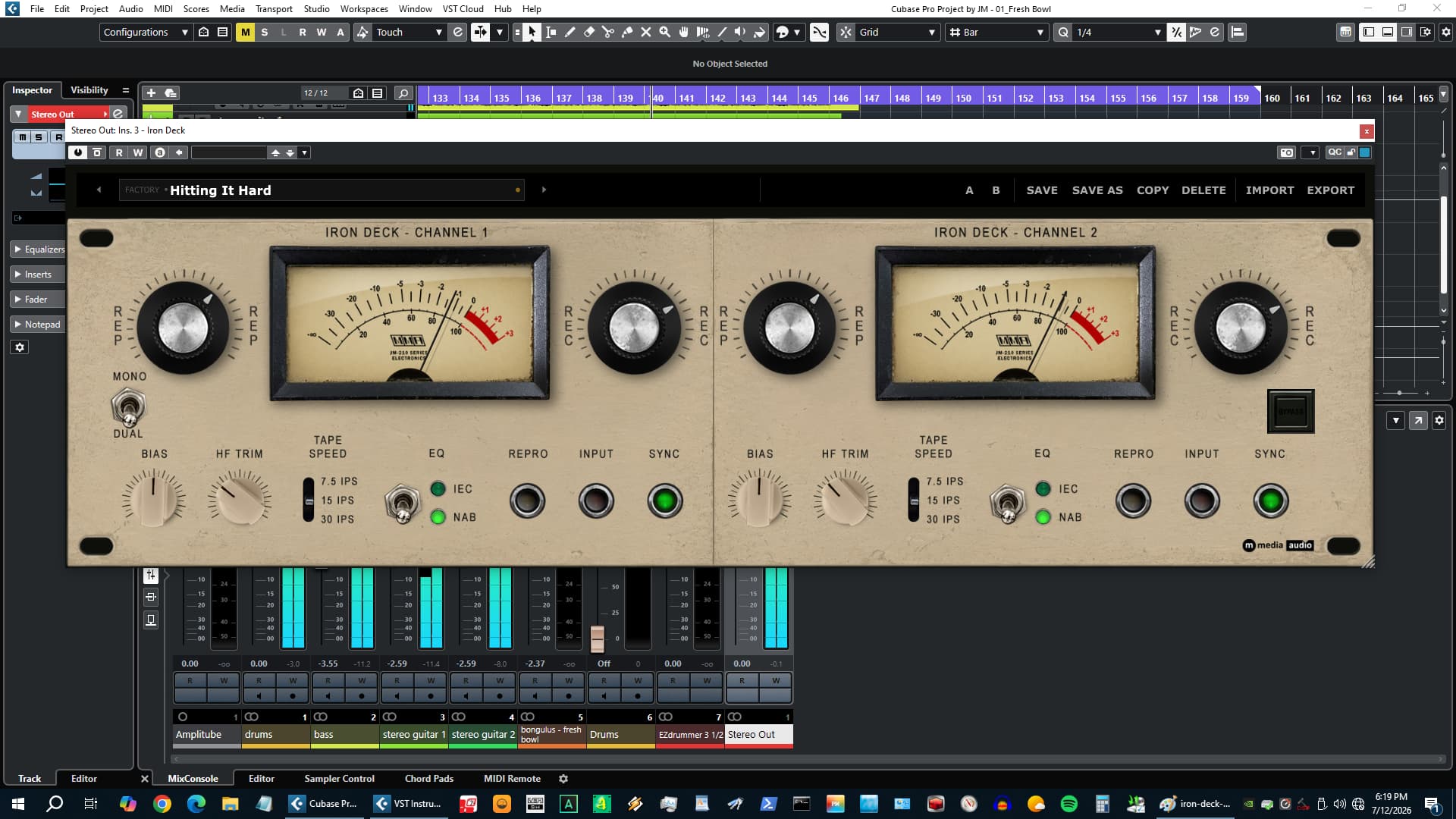
REPRO mode, 30 IPS, REC at noon. That's a good starting point.
Then push the REC and feel it grab.
No account required - we send the link to your email. Full version, no time limit, no demo mode.
The Drive Engine
On a real tape machine, record level is not just gain - it is the primary variable that determines how the machine behaves. Low record level and the tape barely saturates. Push record level and the physics change: the soft nonlinear transfer function starts rounding peaks, even-harmonic content builds up, and a natural RMS compression engages from the same circuit. Iron Deck models this directly. The REC knob controls drive into a tanh-based saturation stage with a soft-knee RMS compressor immediately behind it. At 9 o'clock it adds almost nothing - a light kiss of even-order warmth. At noon you start hearing the tape grab. Past noon the compression and harmonic content are audible and intentional. The REP knob is output level, post everything - bring it back where you need it after you've driven the iron as hard as the track can take.
Three Signal Path Modes
REPRO is the reproduce head path - IEC or NAB EQ fully active, full saturation from the REC drive, the complete tape circuit from front to back. This is the mode to reach for when you want the track to sound like it came off a reel. INPUT is the record amplifier path: minimal tape coloration, transparent solid-state character that adds subtle drive at high REC settings but stays clean at moderate levels. This is the mode for a source that needs the dynamic control without the tonal weight - drums, clean guitars, sources that need handling but not transformation. SYNC is the sync head monitoring sound: a mid-forward EQ curve, slightly different from REPRO, a subtle top-end compression. Engineers recording overdubs ran through the sync head for monitoring when the machine was in record - SYNC captures that specific quality, sitting between the full reproduce character of REPRO and the transparency of INPUT.
Tone Controls
The IEC/NAB switch selects the playback EQ curve. IEC brings more top-end clarity and a slightly leaner low end - the European standard, brighter and more present. NAB gives more low-end weight and warmth, the classic American tape character that most engineers think of when they think of tape. The switch is active in all three modes. Tape speed changes the frequency response shelving: 7.5 IPS adds LF weight and softens the HF, giving a thicker, darker character with slightly more saturation feel. 15 IPS is baseline. 30 IPS lifts the HF and trims a touch of low end, giving a faster and more open character with less apparent saturation. The BIAS knob adjusts the harmonic ratio and HF response across a trim range above and below nominal. Turn it counter-clockwise for under-biased character: HF is lifted, more third-harmonic content, brighter and more aggressive. Turn it clockwise for over-biased: HF softens, more second-harmonic warmth, the rolled-off sound of tape pushed past optimal. The HF TRIM knob is a final shelving low-pass, independent of everything else - dial it down to taste when the top end is right and you just want a touch more air rolled off.
Two Machines, One Insert
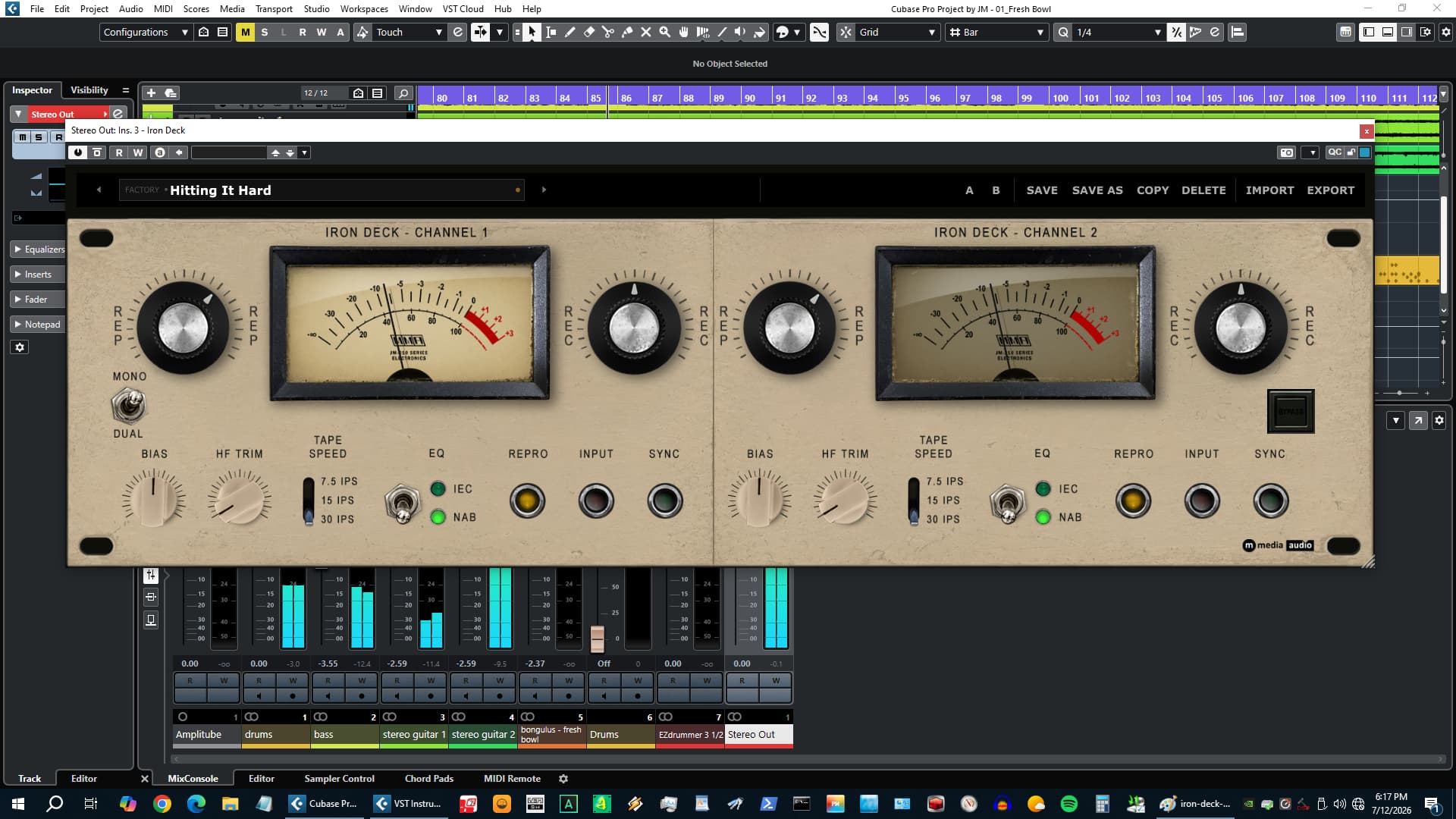
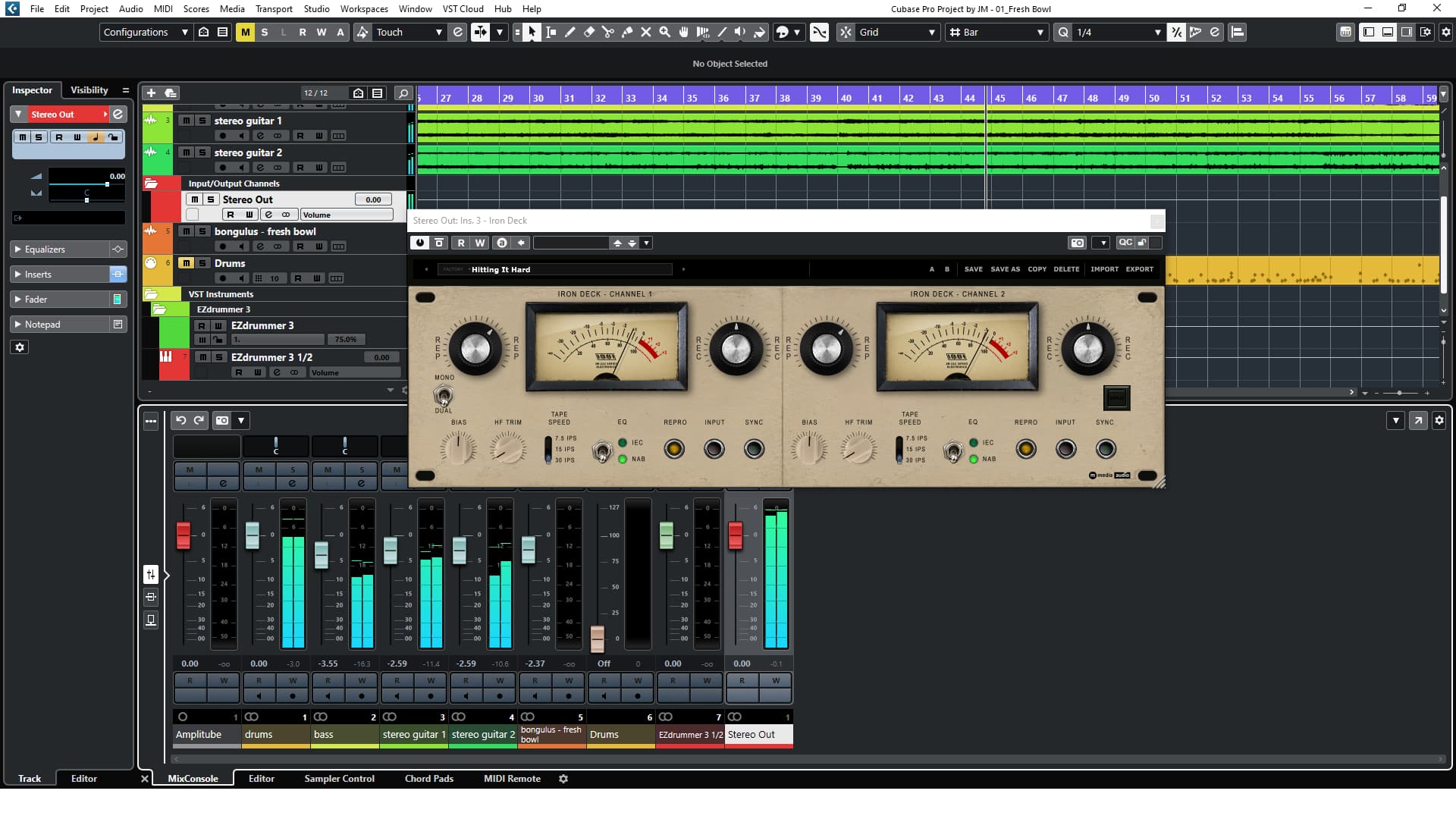
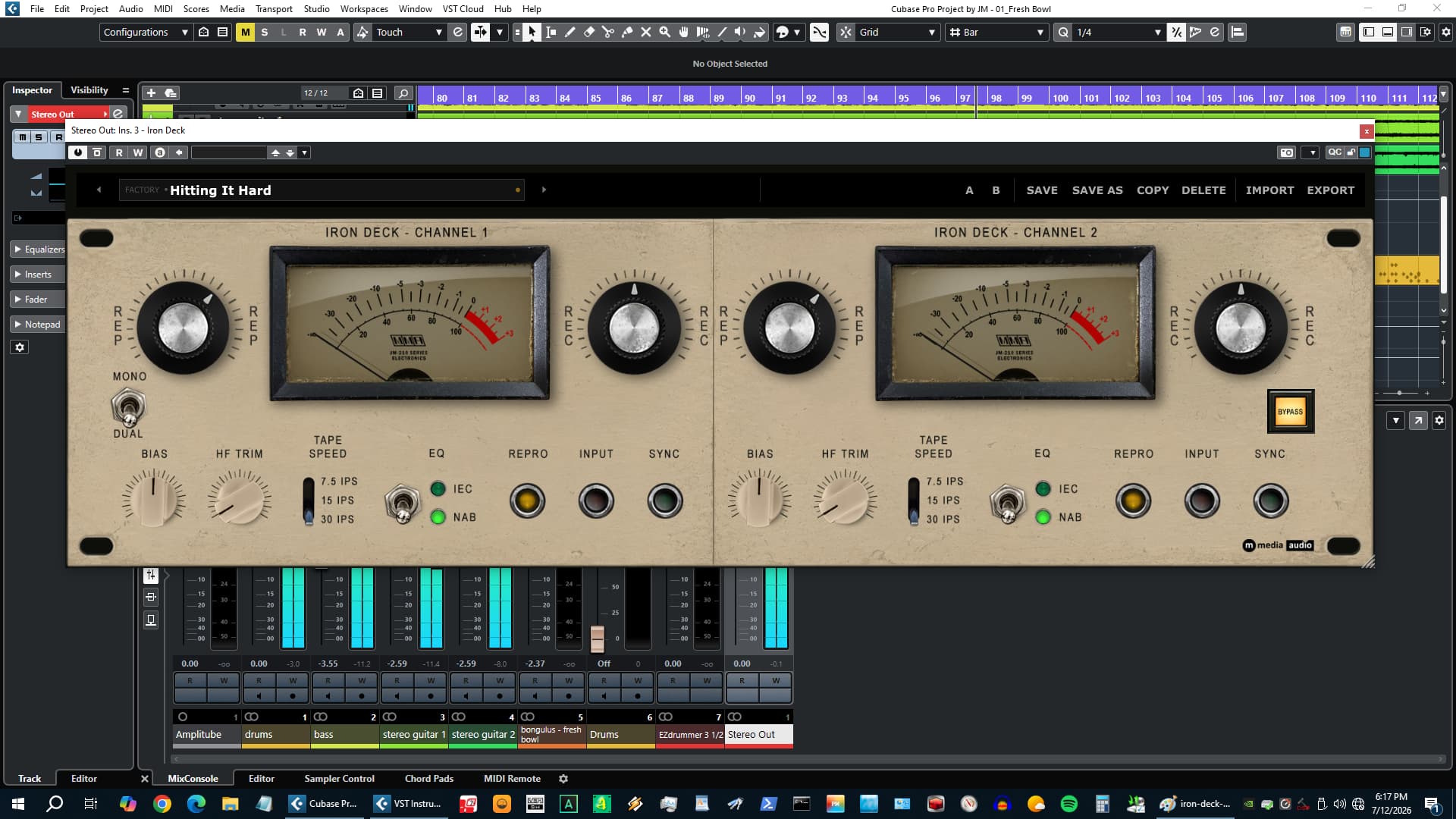
Iron Deck is not a stereo plugin with linked controls - it is two completely independent tape machine channels sharing a single enclosure. REC, REP, BIAS, HF TRIM, TAPE SPEED, IEC/NAB, and REPRO/INPUT/SYNC are all per-channel with their own states and DSP paths. Run both channels identically for a matched stereo pair. Drive the left harder than the right. Set channel one to NAB and channel two to IEC. Use SYNC mode on one side and REPRO on the other. The channels do not know about each other. Load it on a stereo bus and the left and right sides operate completely independently through the same circuit. Load it on a mono track and the left channel activates, the right panel goes dark, the plugin responds as a single mono tape machine. The DAW drives the bus configuration automatically - no settings to change.
A single instance at moderate REC adds the kind of weight and presence that used to require running a track through a real machine. Pushed harder on a drum bus, it rounds transients and pulls the kit together in a way that compression alone cannot replicate - because the harmonic content is doing half the work. On a mix bus it adds the gentle, physical cohesion of a tape path. On a single vocal track it makes the performance feel like it was captured on something with character. Load up a preset, push the REC to where it feels right, and move on. The iron does the rest.
The combination of tape saturation, smooth RMS compression, multiple signal paths, variable tape speed, and IEC and NAB equalization offers a surprisingly wide range of sonic possibilities. The fully independent dual channels, in particular, open up creative applications rarely found in free plugins.
Andreasbuenasideas.de
No subscription, no expiry, no catch. Download it, use it on every session.
Enter your email, we send the download link. Nothing else required.
Windows VST3, macOS VST3 and AU (Universal Binary), Linux VST3. One download covers all.
You email us, we answer. No ticket queues, no bots.
VST3 (64-bit) - Windows, macOS, Linux
AU (64-bit) - macOS only
Windows 10 / 11
macOS 11 Big Sur or later (Apple Silicon + Intel)
Linux - Ubuntu 22.04+ or equivalent
Any VST3-compatible host: Reaper, Cubase, Studio One, Ableton Live, FL Studio, Bitwig Studio, Nuendo, and more
AU (macOS): Logic Pro, GarageBand, MainStage
Free - no license key required
Unlimited installs
No activation server
No telemetry
SHA-256 (mmedia-iron-deck-v1.0.1.zip): c8b5525f761dbcde9ac52ba1d52f4bedd653a88685b8f1879db7f2da0dedf285
Free. No account, no activation, no expiry.
By downloading you agree to our EULA and Privacy Policy.
Gyro 1.2 introduces a Global Key Lock function that adapts newly loaded presets and chord sets around a user-selected key, new chord-generation tools that help to create fresh harmonic ideas,...
Cherry Audio’s latest soft synth faithfully recreates the Gleeman Pentaphonic, a vintage synth that was known not only for its sound but also for its distinctive looks.
BeatSkillz is offering Slam2, its track phattener plugin for macOS and Windows, for free with the code SLAMJAM. Slam2 was heavily discounted when we covered it back in 2021. It is currently listed at...